News
SA’s space agency flags severe geomagnetic storm, what South Africans should know
SA’s space agency flags severe geomagnetic storm, what South Africans should know
If your phone battery drains a little faster today or pilots start talking more about “space weather”, there’s a reason. South Africa’s National Space Agency (Sansa) has confirmed that a powerful geomagnetic storm is interacting with Earth’s magnetic field and conditions could remain unstable through Tuesday.
While it may sound like science fiction, this is very real space weather, and it’s being closely watched from Sansa’s monitoring centres.
What triggered the storm?
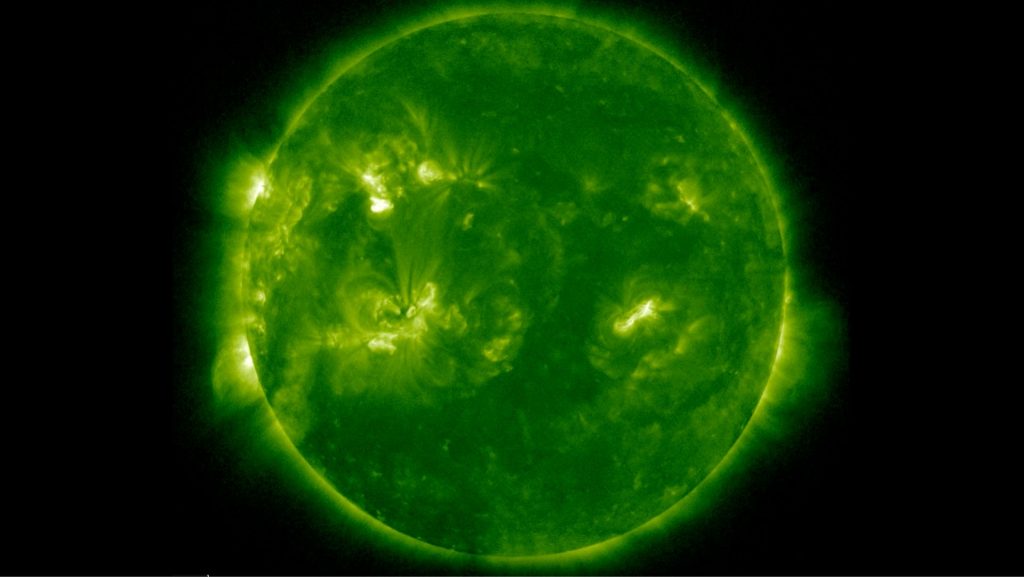
The disturbance began with a dramatic event on the Sun over the weekend. A strong solar flare, classified as an X1.9, one of the most powerful categories, erupted on Sunday. Solar flares are sudden bursts of energy and light from the Sun, ranked from weakest to strongest as A, B, C, M and X.
That flare unleashed a coronal mass ejection (CME): a vast cloud of charged particles hurtling through space at extreme speeds. According to Sansa, these clouds can travel at up to 2,000 kilometres per second and typically reach Earth within a day or two if they’re aimed our way.
By late Monday night, Sansa confirmed the CME had arrived and the geomagnetic storm had already intensified to G4 level, classified as “severe”.
Why South Africans weren’t affected immediately
Interestingly, the intense solar flare itself didn’t cause radio blackouts across Africa. That’s because it erupted at night, when our region sits mostly outside the flare’s direct impact zone.
The bigger concern comes after the flare, when the CME collides with Earth’s magnetic field. That interaction is what causes geomagnetic storms, and that’s what is unfolding now.
What happens during a geomagnetic storm?
Unlike thunderstorms or heatwaves, geomagnetic storms don’t knock down trees or flood streets. Most people won’t notice anything unusual at all.
But technology can feel the impact.
Sansa warns that systems relying on precise navigation and communication are the most vulnerable. These include aviation, drone operations, satellite-based navigation and, in rare cases, electricity networks. Operators are advised to watch the K-index, a global scale from 0 to 9 that measures how disturbed Earth’s magnetic field is.
On Tuesday, conditions are expected to fluctuate between minor (G1) and strong (G3) levels, with the possibility of renewed G4 activity.
Online reaction: curiosity, not panic
As news of the storm spread, social media lit up with a familiar mix of curiosity and humour. Some South Africans joked about finally seeing the northern lights from Gauteng, while others asked whether loadshedding could somehow be blamed on the Sun.
Experts have been quick to reassure the public: geomagnetic storms are closely monitored, and South Africa’s infrastructure operators are well aware of the risks.
The bigger picture: why space weather matters
Events like this are reminders that Earth doesn’t exist in isolation. The Sun’s activity follows an 11-year cycle, and scientists expect more frequent and intense solar events as we move through the current solar maximum.
For Sansa, these moments are exactly why space weather monitoring matters, not for alarm, but for preparedness.
The takeaway? Keep calm, stay informed, and let the scientists do the worrying. Space may be restless this week, but for most South Africans, life on the ground will carry on as usual.
{Source: The Citizen}
Follow Joburg ETC on Facebook, Twitter , TikTok and Instagram
For more News in Johannesburg, visit joburgetc.com