News
DJ the loggerhead turtle’s 1,000km journey back to the wild
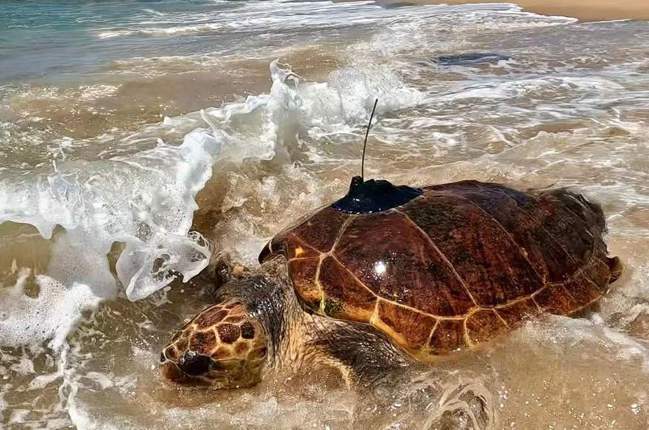
There is something quietly powerful about a creature returning to the ocean after spending years learning how to survive again. Along South Africa’s warm eastern coastline, one young loggerhead turtle has become a symbol of exactly that.
DJ, short for Davey Jones, is not just another rescued sea turtle. Her story has travelled almost as far as she has, capturing the imagination of conservationists and ocean lovers who have followed her progress since her release late last year.
Even though her tracking signals have now gone silent, the journey she shared has already left a lasting mark.
From Muizenberg sands to a second chance
DJ’s story began on 8 April 2011 when she was found stranded on Muizenberg Beach in Cape Town. What followed was not a quick rescue and release. Instead, it became a 14-year chapter of patience, veterinary care, and persistence.
After initial stabilisation at the Two Oceans Aquarium, she was moved to uShaka Sea World, where her long rehabilitation unfolded. Her progress was never simple. She battled recurring fungal infections, an early but treatable form of arthritis, and a stubborn skin condition that returned more than once.
Despite these setbacks, the turtle rehabilitation and veterinary teams continued working with her, slowly guiding her back to strength. Over time, DJ became something of a favourite among staff, a reminder of why long-term wildlife care matters.
Cleared for the open ocean
In the past two years, DJ’s health remained consistently strong. Detailed veterinary and behavioural assessments confirmed what the team had been hoping for. She was finally ready to return to the wild.
Before her release in December 2025, she was fitted with a satellite tracking tag sponsored by On Safari Africa, along with an acoustic tag provided by the Oceanographic Research Institute. The goal was to monitor her behaviour and movements as part of both local and international sea turtle tracking efforts.
For conservation scientists, this kind of data is invaluable. It helps build a clearer picture of how rehabilitated turtles adapt once they are back in open water.
An ocean wanderer finds her rhythm
Once free, DJ wasted no time rediscovering her natural instincts. She spent weeks exploring the iSimangaliso coastline, moved through northern KwaZulu-Natal, and crossed into southern Mozambique. Her path included Inhaca Island and Maputo Bay before she gradually drifted back south.
Using the most accurate location points, researchers estimate she covered close to 1,000 kilometres, averaging roughly 24 kilometres a day. For a turtle that had spent 14 years in rehabilitation, that distance tells a powerful story about resilience.
At just 14 years old, she is still too young to nest. This stage of her life is about learning ocean currents, finding reliable feeding grounds, and navigating warm coastal waters. In simple terms, she is doing exactly what a young loggerhead should be doing.
When the signal fades, but the story continues
Her satellite transmissions have since gone quiet. According to the research team, the most likely explanation is a natural tag failure rather than any sign of distress.
In many ways, that silence feels fitting. The technology did its job, offering a rare window into her early months of freedom. What it revealed was exactly what conservationists hoped to see. A strong, active turtle thriving in her natural environment.
On social platforms, ocean lovers have shared messages celebrating her journey, many calling her a symbol of perseverance after years of care, setbacks, and recovery.
Why DJ’s journey matters beyond one turtle
South Africa’s coastline is one of the most important habitats for several sea turtle species, yet these animals face constant threats from pollution, fishing gear, habitat loss, and climate pressures. Long-term rehabilitation programmes like the one that supported DJ are resource-heavy, often stretching over many years.
Her successful return to the ocean is not just a feel-good story. It is proof that sustained conservation work can deliver real results.
For the teams who cared for her, the milestone is both professional and deeply personal. After more than a decade of treatment, watching her swim nearly a thousand kilometres is a rare kind of reward.
As she continues somewhere beyond the reach of her last signal, DJ is likely still cruising warm currents, feeding, exploring, and growing stronger with every tide.
Sometimes the best conservation stories do not end with a headline moment. They carry on quietly, far out at sea.
Follow Joburg ETC on Facebook, Twitter, TikT
For more News in Johannesburg, visit joburgetc.com
Source: IOL
Featured Image: News24