News
While taps run dry, millions of litres spill into Joburg streets

While taps run dry, millions of litres spill into Joburg streets
In Linbro Park this week, the irony was impossible to miss.
As some Johannesburg residents queued for water tankers or opened their taps to a weak trickle, a burst pipe nearby poured clean drinking water down the road, nonstop for days. By the end of the week, it had formed what locals described as a small lake.
That image has now become political ammunition.
Zille points to “a system bleeding water”
DA mayoral candidate Helen Zille visited the site and didn’t hold back. She criticised Joburg Water for what she called a failure to fix infrastructure while residents are being urged to cut back on usage.
“Before households are scolded for over-consumption, fix the leaks,” she said during her visit.
According to Zille, millions of litres have flowed unchecked from the damaged pipe for nearly a week, fresh, treated water meant for homes, schools and businesses.
Her frustration comes as Rand Water continues to throttle supply to Johannesburg in an effort to stabilise the strained system. Residents have been told to use less water, yet many argue they barely have enough coming through their taps to begin with.
Is Joburg really using “too much” water?
Joburg Water has previously indicated that the average resident uses nearly double the international daily average.
Zille disputes that claim.
Citing United Nations guidelines, she pointed out that every person has a right to between 50 and 100 litres of water per day for personal and domestic use. The suggestion that ordinary households are the main culprits behind high consumption, she argues, ignores a more obvious factor: infrastructure failure.
“We are losing millions of litres due to leaks and ageing pipes,” she said.
It’s a view many residents share.
On local community WhatsApp groups and Facebook pages, the photos from Linbro Park sparked outrage. “How are we told to shower for two minutes when this is happening?” one resident wrote. Another commented: “Fix the pipes before blaming the people.”
The bigger leak beneath the surface
The problem isn’t unique to Johannesburg.
In Tshwane, DA mayoral candidate Cilliers Brink said non-revenue water, water that is lost before it reaches customers due to leaks, theft or metering issues, has jumped from 33% to nearly 40% in just a year.
That’s a staggering figure in a country already grappling with water scarcity.
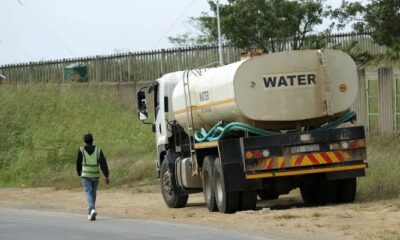
Brink added that expenditure on water tankers in Tshwane has surged by 450%, topping more than R1 billion in the 2024–25 financial year. Tankers have become a common sight in suburbs like Laudium and Atteridgeville, where reservoir levels have dipped dangerously low in recent weeks.
“If municipalities don’t monitor reservoir levels and manage supply in time, it becomes very difficult to correct,” Brink warned.
A crisis hiding in plain sight
South Africa’s water crisis is no longer abstract. It’s visible in cracked infrastructure, in dry communal taps and now, in lakes formed by burst pipes.
Johannesburg’s network of pipes is ageing, much of it decades old. Maintenance backlogs have piled up. At the same time, population growth and urban expansion are placing additional strain on already fragile systems.
When Rand Water reduces supply, municipalities must stretch what they have. But if nearly 40% of that water is lost before it reaches homes, the math simply doesn’t add up.
More than a political moment
Zille’s comments come in the thick of campaign season, and critics may dismiss the visit as political theatre. Yet the frustration on the ground feels less about party politics and more about daily survival.
Water, after all, is not a luxury item. It is a constitutional right.
The images from Linbro Park have struck a nerve because they capture a broader reality: while residents are urged to conserve every drop, the system itself appears unable to stop the bleeding.
And until burst pipes are repaired as urgently as press statements are issued, Joburg’s water crisis will keep spilling out, quite literally into the streets.