News
Paul O’Sullivan reveals how politics compromised policing during Selebi era
Paul O’Sullivan reveals how politics compromised policing during Selebi era
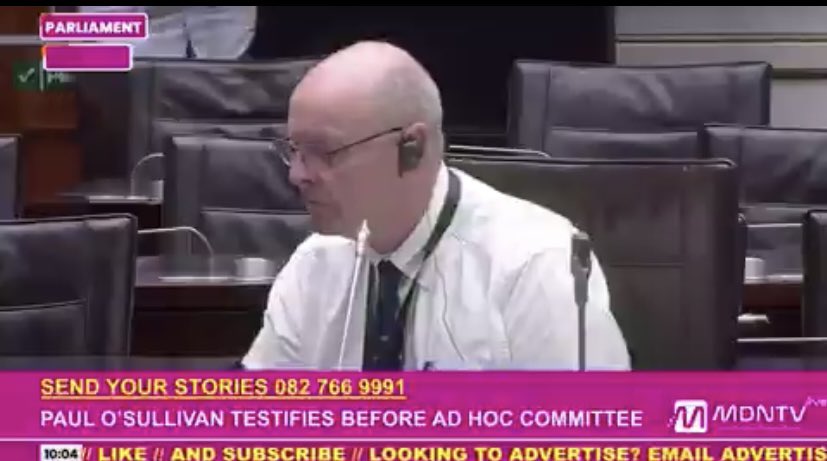
In a dramatic testimony before Parliament’s ad hoc committee, former police reservist Paul O’Sullivan painted a vivid picture of how political maneuvering and high-level misconduct weakened South Africa’s policing system during the late 2000s.
At the heart of his account was Jackie Selebi, the former national police commissioner whose dual role as a senior ANC politician and head of SAPS directly contravened the South African Police Service Act.
“Part of the problem is the Police Service Act makes it clear that no police official may be an active politician. At the time Jackie Selebi was the commissioner of the police, he was also a member of the National Executive Committee of the ANC,” O’Sullivan told the committee. “Suddenly the rules of the Police Service Act were being flouted.”
The Mbeki–Zuma feud and law enforcement
O’Sullivan argued that the political rivalry between former president Thabo Mbeki and his deputy Jacob Zuma, which came to a head during the 2007 Polokwane conference, created conditions for political interference in criminal investigations. He said that during this period, the now-defunct Scorpions unit faced pressure while investigating high-level corruption cases.
“The spy tapes make it clear that there was a concerted effort on the part of certain persons, one of them being the then head of the Scorpions, Leonard McCarthy,” O’Sullivan said. The tapes allegedly documented coded conversations aimed at protecting Selebi while undermining Zuma, influencing the timing of legal proceedings.
These recordings later became pivotal in Zuma’s legal battles. In 2009, they were cited as justification for withdrawing corruption charges against him, a decision later overturned by the courts.
O’Sullivan under scrutiny
O’Sullivan also revealed that he himself was targeted. “In the spy tapes, it is stated categorically, ‘Let us not worry about O’Sullivan, we will bring somebody in that will deal with him decisively.’ I felt that I did the right thing,” he said.
For O’Sullivan, the investigations were principled, not political. He traced the origins of the Selebi case to his work, which led to the arrest and prosecution of Selebi for corruption in 2010. Selebi was sentenced to 15 years’ imprisonment for receiving payments from convicted drug trafficker Glen Agliotti. He later died in 2015 after being released on medical parole.
High-stakes investigations
O’Sullivan also discussed his involvement in the seizure of drugs valued at R200 million and the arrest of Agliotti. Evidence of Agliotti’s payments to Selebi emerged through plea agreements, forming the backbone of the prosecution’s case.
“I wanted to live in a country where there is the rule of law. I didn’t want to live in a country where a chief of police could be so corrupt that he could enter into an agreement that could assist a sitting president to arrest and charge a future possible president,” O’Sullivan told the committee.
Parliamentary inquiry into systemic failures
The ad hoc committee is examining whether political interference and misconduct at senior levels compromised investigations within SAPS and other law enforcement bodies. O’Sullivan’s testimony highlighted how personal alliances, political feuds, and breaches of law at the top echelons of policing created an environment where justice was vulnerable to manipulation.
His account underscores a stark lesson for South Africa: the integrity of law enforcement can be undermined not only by corruption but also by the entanglement of politics and policinga cautionary tale that still resonates today.
{Source: IOL}
Follow Joburg ETC on Facebook, Twitter , TikTok and Instagram
For more News in Johannesburg, visit joburgetc.com