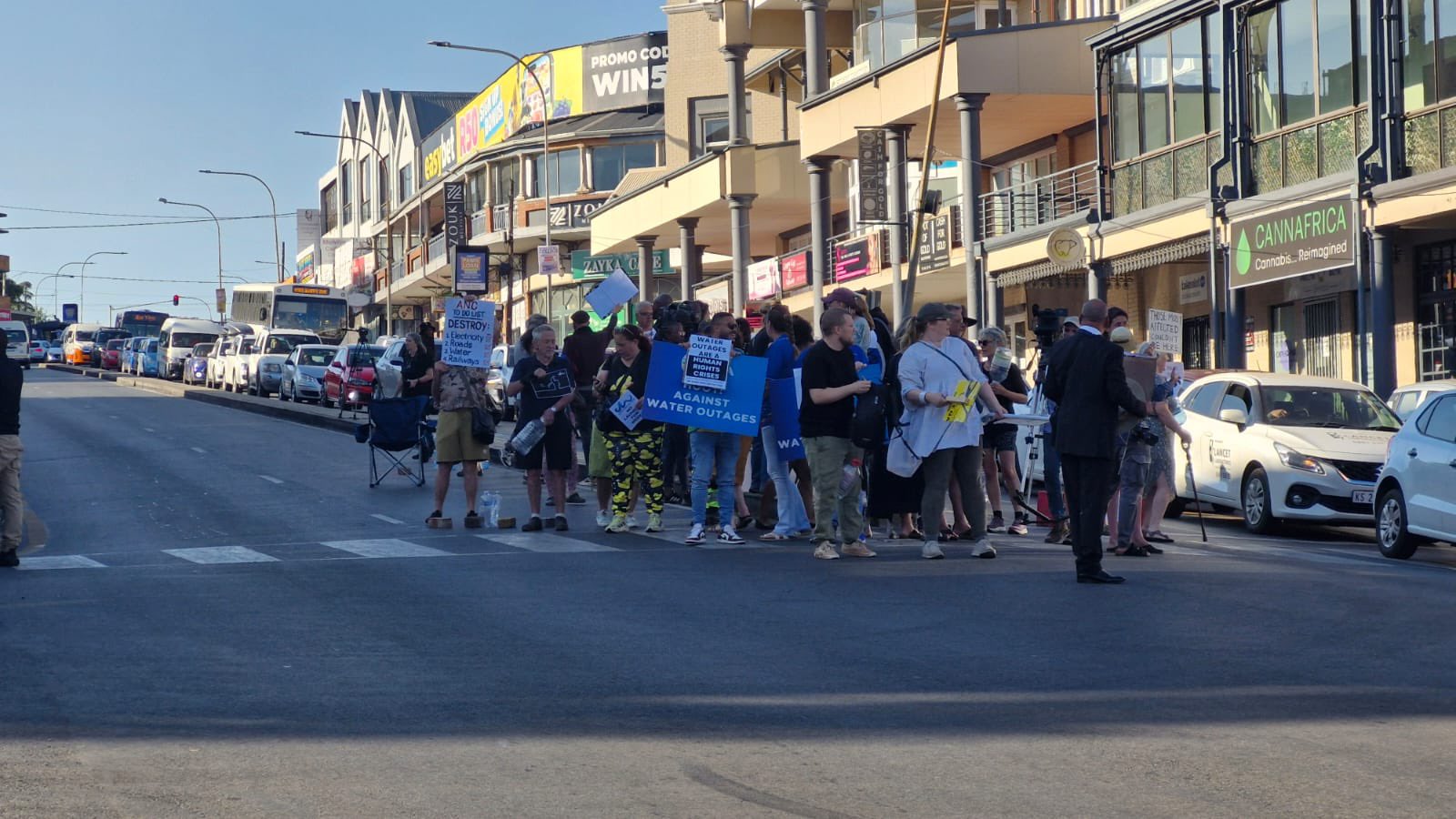
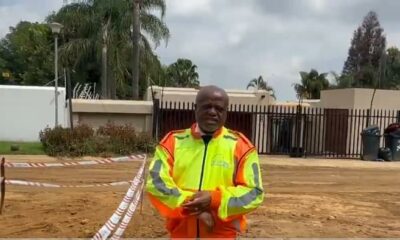
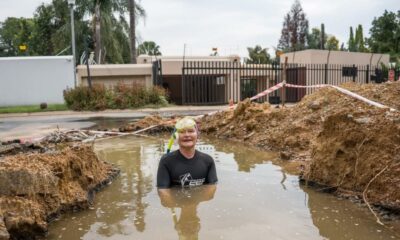
Sourced: X {https://x.com/ferialhaffajee/status/2021468180129185984?s=20}
There’s a particular sound that’s become too familiar in parts of Johannesburg. It’s not the roar of traffic or the hum of the city. It’s the hollow echo when you turn a tap and nothing comes out.
For Faith Modise, that sound has been the soundtrack to her new life in Midrand. The 23-year-old moved to the area in October last year, hoping to settle into a place where she could build routine and independence. Instead, she’s learned something else entirely.
“I need water for literally every single thing,” she says quietly. “And I don’t have people around that are closer. I don’t even have contacts to say, ‘Hey, can you please bring me water?’”
She doesn’t own a car. She doesn’t have spare cash to buy water every week. But she’s had to. More than R100 so far, on a budget that never accounted for bottled baths and bought cooking water.
Then there are the cockroaches. They arrived when the dishes started piling up. “I don’t wash every single day,” she explains. “Because if I let it wait for two days, maybe the water will come back.”
Faith is one of thousands. But in Zandspruit, one of Johannesburg’s oldest and largest informal settlements, the number is closer to 40,000 people. And they share two water tankers.
‘They just say tomorrow, tomorrow, tomorrow’
Willie Mabunda has lived in Zandspruit for nearly 22 years. He’s watched the settlement swellPhomolong, Maseru, Kananaand he’s watched the water disappear.
“The problem escalated in 2024,” he says. “But it started way back in 2017.”
His community has taps. Functional, installed, ready-to-use taps. They’ve just been dry since early last year.
What happened? Mabunda believes he knows. Some residents in lower-lying areas, he says, have cut into the main pipes and laid their own lines. They’re selling water door-to-door now, charging monthly fees for connections that were never theirs to take.
“We investigated,” he says. “We found there’s a guy down there. Not one man. Two or three. They put the pipe in your yard, and you rent the water each month.”
The councillor knows. Joburg Water knows. Technicians came in November 2025, looked around, and left. Mabunda says the utility keeps promising, keeps investigating. But the illegal connections keep coming back, usually at night, when no one’s watching.
“They are not doing enough,” he says flatly. “We want to hold Johannesburg Water accountable. They need to come here with the police.”
A city running on borrowed water
It’s tempting to frame this as an informal settlement problem. It’s not.
In Randburg, small business owners are bleeding money. Bafana Dube, 24, runs a cooking business near the taxi rank. His customers are mostly taxi drivers, men who want a hot meal at 6am before the first shift.
But when there’s no water, there’s no cooking. And when there’s no cooking, there’s no customers.
“We end up spending R80 just to pay someone to get water for us,” he says. “And if there’s no water the whole week, we still have to cover gas, stock, everything.”
A late startsay, 8am instead of 6amcosts him R400 to R500 in lost sales. That’s not a bad day. That’s a collapse.
Nearby, car washers Marumo Marumo and Tshwarelo Mofoatsana are facing the same math problem. Marumo, originally from Lesotho, started his business in March 2025. He buys water in a garbage bin for R20. That’s enough to wash three cars. One car earns him R60 to R80. On a good day, he clears R400.
“When there’s no water, there’s no business,” he says. “Nothing.”
‘Sometimes we drink rubbish water’
David Mavimbela doesn’t run a business. He survives. The 51-year-old makes a living helping shoppers carry luggage near Randburg Square. But for sixteen months, he’s been fighting a different kind of weight.
“We have been suffering with water for sixteen months,” he says. “I don’t know who is going to help us.”
Desperation has pushed him to places no one should go. “Sometimes we drink rubbish water,” he admits. “We will end up getting sick.”
He’s reported the problem to Joburg Water. Officials walk the streets, he says, and promise action. “They just say ‘tomorrow, tomorrow, tomorrow.’ They are promising, but they don’t come.”
Ward 102 councillor Bea Campbell-Cloete confirms the crisis isn’t imagined. In Blairgowrie and surrounding areas, ageing asbestos pipes are bursting weekly. Grosvenor Road. Crawford. Residents go days without supply.
“It’s not just inconvenience,” she says. “It’s health, sanitation, and huge extra costs for families and small businesses.”
Some residents have boreholes. Some have JoJo tanks. But she’s clear: these are patches on a wound that needs surgery.
The official version
Joburg Water says the system is strained. Midrand reservoirs are critically low. Randburg is recovering, but high demand keeps destabilising supply. The Waterval Tower has improved. Quellerina is supplying fairly.
Ronny Mabophe, depot manager for Operations Networks in Randburg, won’t give timelines. “Midrand is a work in progress,” he says. “We cannot confirm when full supply will be restored.”
On Zandspruit, he acknowledges the illegal connections. He confirms the two tankers. When pressed on whether that’s enough for 40,000 people, his answer is careful: “We will need to investigate if the two water tankers cannot supply the entire area.”
Councillor David Mangena of Ward 114 offers a different explanation. He says the shortage is due to “land invasion” and illegal connections. He confirms two tankers are runningdown from sevenand blames the budget.
He also claims a tender is in place to extend water supply to invaded land. Mabophe denies this. No tender, he says. Just a feasibility study, still ongoing since November 2025.
What nobody’s saying
Here’s the part that gets lost in the statements and technical briefings: Johannesburg knew this was coming.
The city is growing at a brutal pace. Midrand is swelling. Informal settlements are spreading. The pipes, in many cases, are older than the people living above them. Asbestos doesn’t last forever. Neither does patience.
Faith Modise puts it plainly: “I know the place is growing at a very rapid rate. They could have planned for such things.”
She’s right. This isn’t a natural disaster. It’s infrastructure neglect, layered with budget constraints, illegal tapping, and a response system that moves at the speed of a dripping tap.
The water tankers aren’t a solution. They’re a symptom. When 40,000 people rely on two trucks, you’re not delivering aid. You’re managing collapse.
The human cost
Behind every statistic is someone trying to wash a dish. Someone trying to keep a business alive. Someone deciding whether to spend R20 on water or food.
Bafana Dube doesn’t want sympathy. He wants consistency. “I don’t think it bothers them,” he says of the officials. “There’s a big problem with this thing.”
Marumo Marumo wants to keep washing cars. David Mavimbela wants to stop drinking dirty water. Faith Modise wants to stop calculating how many dishes she can leave before the cockroaches come.
None of them are asking for much. Just what comes out of a tap, in a city that’s supposed to be Africa’s economic capital.
Tomorrow, the officials say. Tomorrow.
But in Midrand, Randburg, and Zandspruit, tomorrow has already come and gone. And the taps are still dry.