News
MJC raises alarm over electronic death certificate rule and its impact on Muslim burials
MJC raises alarm over electronic death certificate rule and its impact on Muslim burials
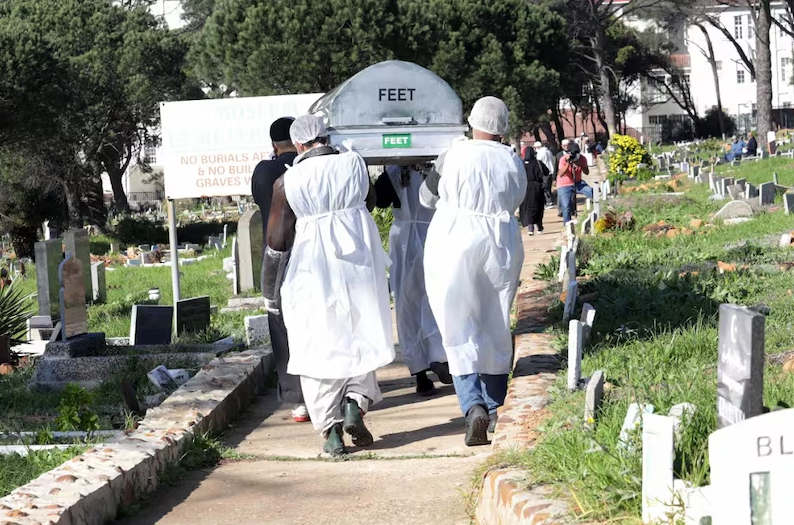
In many Muslim homes, when death comes, time moves quickly.
Family members gather. Ritual washing begins. Prayers are arranged. Burial often takes place within hours sometimes the same day. It is not simply tradition. It is religious duty.
That is why a proposal in a recent government White Paper has stirred unease within parts of the Muslim community.
The Muslim Judicial Council (MJC) says draft legislation that could require an electronic death certificate before burial may interfere with Islamic funeral practices that emphasise prompt burial.
Sourced: Cape Argus
A question of timing and dignity
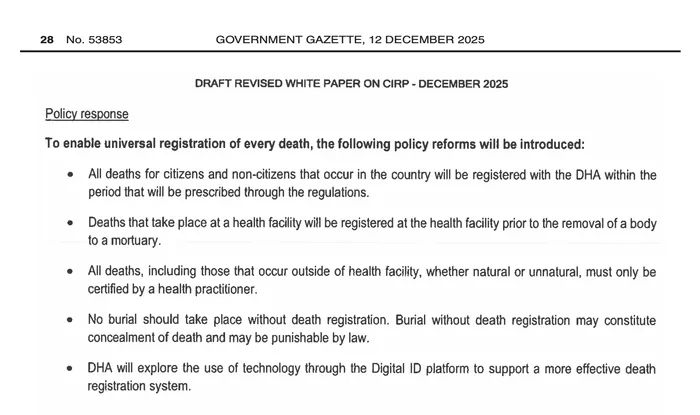
The proposal forms part of the Draft White Paper on Citizenship, Immigration and Refugee Protection, published in Government Gazette No. 53853 of 12 December 2025 by the Department of Home Affairs.
At the heart of the concern is administration: registering a death before burial rather than afterwards.
The MJC says Islamic jurisprudence requires that burial be carried out as quickly as reasonably possible. According to the council, this principle is tied to human dignity and forms part of a collective religious obligation.
Importantly, the council notes that this urgency is not unique to Islam. Certain Jewish and Christian traditions also emphasise burial without undue delay, a reflection of South Africa’s broader religious diversity.
The MJC has stressed that it does not oppose lawful processes in cases where forensic investigations or medico-legal examinations are necessary. In such instances, it says, the Muslim community has historically cooperated fully with authorities.
But it draws a firm line at what it describes as a “generalised statutory delay” where no criminal or legal grounds exist to hold a body.
Undertakers say the rule isn’t new
Interestingly, not everyone in the sector views the proposal as a dramatic shift.
The Western Cape Muslim Undertakers Forum says the requirement to register a death before burial has existed in legislation for years.
Chairperson Ebrahim Solomon, an undertaker with more than three decades of experience, explains that in practice, Muslim undertakers have often buried first and then registered the death within the required 48-hour window.
According to Solomon, the key difference in the draft is the clearer possibility of prosecution for non-compliance.
“As Muslims, we were trusted,” he said, noting that exemptions were effectively granted in practice. What the sector now wants is clarity, preferably written into the legislation, confirming when exemptions may apply.
For undertakers working against the clock to fulfil religious obligations, uncertainty creates anxiety.
Government cites fraud concerns
Home Affairs has since clarified that the law already requires deaths to be formally recorded before burial, but that compliance has not always been consistent.
Officials warn that when deaths are not promptly and accurately registered, the population register becomes unreliable. In some cases, deceased individuals remain listed as alive, creating opportunities for fraud and identity theft.
From the department’s perspective, tightening enforcement protects the integrity of the civil registry.
From the MJC’s perspective, any blanket rule that delays burial without lawful investigative reason may infringe on constitutionally protected religious freedom.
A deeper balancing act
South Africa’s Constitution strongly protects freedom of religion. But it also allows for limitations where justified and proportionate.
Legal analysts say the debate will likely centre on proportionality: can government achieve its administrative goals through less restrictive means that do not interfere with religious burial rites?
On social media, reactions have been mixed. Some South Africans support stricter controls to prevent identity fraud. Others argue that administrative efficiency should not come at the cost of religious dignity.
In communities where burial typically happens within 24 hours, even a short delay can feel significant.
What happens next?
The MJC has indicated it will formally object to any provision that directly or indirectly obstructs prompt Islamic burials where no lawful reason for delay exists. If necessary, it says it will pursue appropriate legal and constitutional channels.
Meanwhile, undertakers are calling for practical solutions, such as explicit exemptions in clearly defined circumstances to avoid confusion on the ground.
At its core, the issue is not only about paperwork.
It is about how a modern state balances administrative control with centuries-old faith practices. It is about ensuring that systems designed to prevent fraud do not unintentionally wound the dignity of grieving families.
And for many, it is a reminder that in matters of death, timing is not just procedural it is profoundly human.
{Source: IOL}
Follow Joburg ETC on Facebook, Twitter , TikTok and Instagram
For more News in Johannesburg, visit joburgetc.com