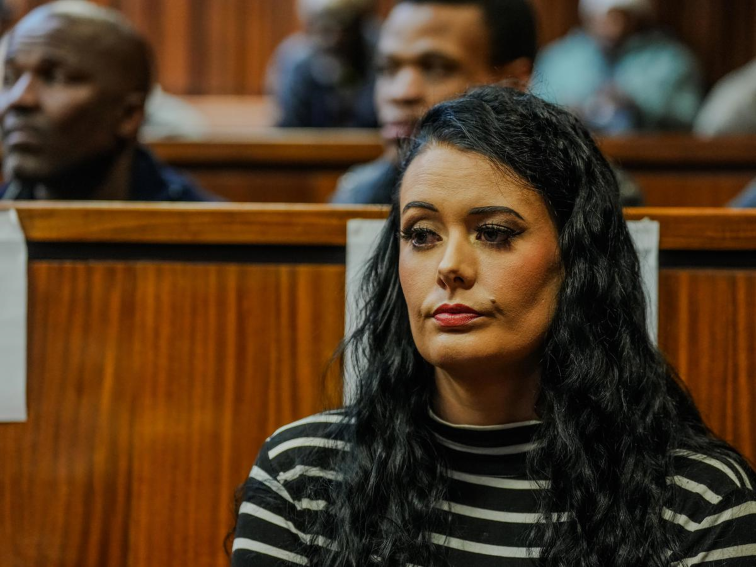
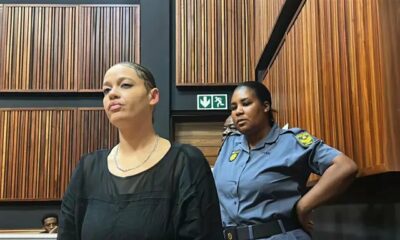
The courtroom was silent when Amber-Lee Hughes spoke.
Not the restless kind of silence that usually hangs over the Johannesburg High Court, but the heavy, uncomfortable kind, the sort that makes you aware of every breath in the room.
On Wednesday, Hughes returned to the stand after two postponements to finalise consultations with her legal team. Convicted of the premeditated murder and rape of four-year-old Nada Jane Challita, she is now pleading for mercy ahead of sentencing.
And it was one sentence in particular that left the court reeling.
“I thought that it would have been better if Nada was dead than to just be with her father.”
A confession built on anger and betrayal
Hughes told the court the events of 2023 did not unfold in isolation. She described a relationship strained by betrayal, saying she had discovered that Nada’s father had been unfaithful.
“On that day, it felt like everything that had happened throughout our relationship had built up, and I snapped,” she testified.
According to her account, she had intended to take both her own life and the child’s. Instead, she drowned little Nada in a bathtub filled with cold water.
Her explanation that she believed death was better than leaving the child with her father has sparked intense public anger. Across social media, many South Africans have rejected any suggestion of justification, calling the crime “unforgivable” and demanding the harshest possible sentence.
A troubled past laid bare
As part of the sentencing proceedings, the court heard details of Hughes’ upbringing and mental health history.
She testified that between the ages of 14 and 16, she attempted suicide multiple times. She attributed those years to depression and instability at home. Despite that, she completed matric and later worked in promotional modelling and waitressing.
A family connection led her to Baby Steps preschool in November 2020, where she started as an intern. By February 2021, she was formally appointed as a teacher.
But cracks began to show.
Hughes admitted she struggled with attendance and responsibility. She was transferred to another branch and demoted in 2022.
“I was falling short,” she told the court. Eventually, she resigned.
For many observing the case, that detail is especially unsettling a woman who once worked with children now convicted of killing one.
“I always wanted to plead guilty”
In a surprising revelation, Hughes told the court she had wanted to plead guilty to murder from the beginning of the legal process.
She claimed her previous legal team advised against it.
“One of the most common questions I was asked by several doctors was how I would like to plead. I stated to them that I would like to plead guilty,” she said.
Whether that assertion will influence sentencing remains to be seen.
Trauma, PTSD and borderline personality disorder
In October 2025, social worker Johanna Wolmarans presented her assessment of Hughes to the court.
Wolmarans testified that Hughes had been exposed to traumatic events from the age of six and was later diagnosed with post-traumatic stress disorder (PTSD). She also suffers from borderline personality disorder (BPD), the court heard.
According to the social worker, those conditions severely affected Hughes’ ability to regulate emotions.
“She cannot deal with frustration. She cannot deal with anger,” Wolmarans testified.
The report suggested that Hughes lacked the emotional tools to direct her anger at its true source. Instead, the anger built throughout the day until it culminated in the fatal act.
Mental health professionals often stress that trauma can profoundly shape emotional responses. But as legal experts point out, diagnosis does not automatically equal diminished responsibility particularly in cases involving premeditation.
A nation watching
The murder of Nada Jane Challita has shaken Johannesburg and beyond. In a country already grappling with high rates of violence against women and children, this case has reopened painful conversations about child protection, domestic conflict, and the intersection between mental health and criminal accountability.
On community forums and local Facebook groups, the sentiment has been largely unforgiving. Many users have expressed sympathy for the child’s family while insisting that mental illness cannot excuse what happened.
At the same time, others have cautiously noted the importance of understanding not excusing how untreated trauma can escalate into catastrophic outcomes.
What happens next?
Sentencing proceedings are still ongoing.
The court must now weigh competing realities: a four-year-old life violently cut short, and a convicted woman who says years of trauma and untreated mental illness left her unable to cope with betrayal and emotional overwhelm.
Ultimately, the judge’s decision will not only determine Hughes’ future. It will also send a broader message about how South Africa balances mercy, accountability, and justice in cases that defy comprehension.
For now, one thing remains undeniable: at the centre of it all was a little girl whose life ended far too soon.