News
No party banners in Cabinet, Ramaphosa warns GNU ministers
No party banners in Cabinet, Ramaphosa warns GNU ministers
“In the Cabinet, there are no parties”
South Africans are used to political point-scoring. It’s almost part of our national soundtrack, sharp jabs in Parliament, party T-shirts on street corners, fiery soundbites on X before the evening news even airs.
But this week, President Cyril Ramaphosa drew a line.
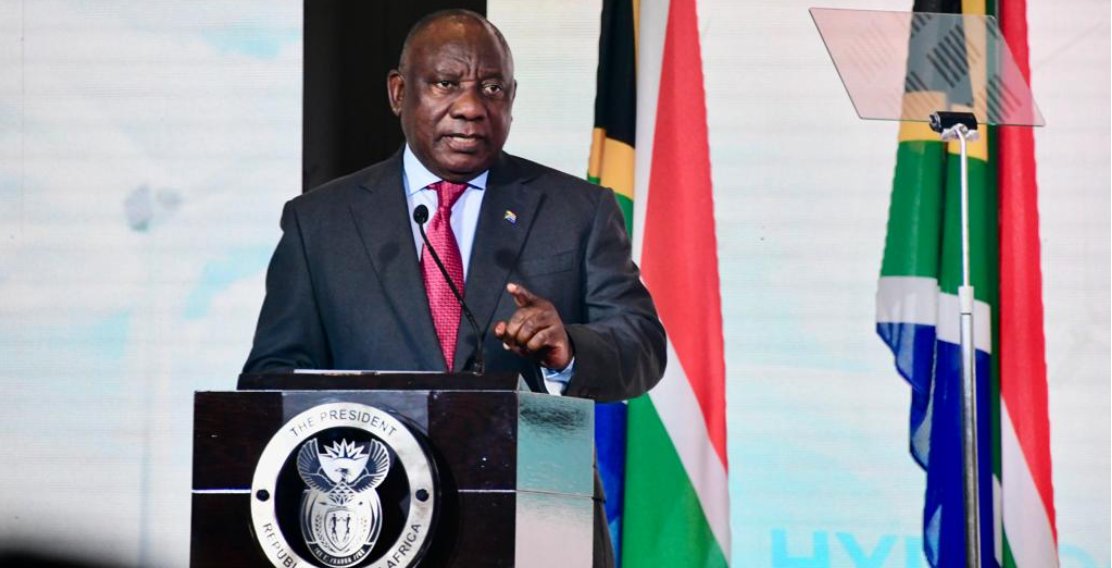
Addressing ministers and deputy ministers in the Government of National Unity (GNU), Ramaphosa made it clear: what happens inside Cabinet cannot be turned into campaign material.
“When they are out on the streets, they campaign for their parties. But in the Cabinet, there are no parties,” he said.
The message was blunt. No ANC ministries. No DA ministries. No IFP or PA portfolios. Just one collective executive tasked with delivering on a shared programme, the Medium Term Development Plan.
In a coalition still finding its rhythm, it sounded less like a suggestion and more like a warning.
A coalition born from necessity
The GNU itself is a product of political reality. After the African National Congress lost its outright majority in the May 2024 general election, it entered unfamiliar territory coalition governance.
The result was a broad alliance that includes the Democratic Alliance, Patriotic Alliance, Inkatha Freedom Party, GOOD, Pan Africanist Congress, Freedom Front Plus, United Democratic Movement, Al Jama-ah and Rise Mzansi.
It’s a coalition that many voters never imagined the ANC and DA sharing executive power after years of fierce opposition politics.
And while leaders have publicly committed to stability, tensions have simmered beneath the surface, particularly between the ANC and DA over economic policy and governance reforms. The DA has periodically threatened to walk away, though it has remained, saying it wants to grow the economy, create jobs and fight corruption from within.
Against that backdrop, Ramaphosa’s comments land heavily.
SONA debate reignites old battles
The President’s remarks followed two days of heated debate in a joint sitting of the National Assembly and National Council of Provinces, where MPs scrutinised his State of the Nation Address (SONA).
Opposition parties accused him of recycling promises and failing to deliver on previous commitments. Ministers and deputy ministers defended their departments often speaking in the language of their parties rather than the language of a shared executive.
Ramaphosa appeared to take note.
He reminded Cabinet members that many current achievements are built on foundations laid by predecessors and that projects will outlast individual office-bearers.
“Our successes are the achievements of the collective,” he said, adding that failures and shortcomings are also shared.
It’s a subtle but important shift in tone from party ownership to shared accountability.
The BEE fault line
If there is one policy area that continues to expose ideological divides within the GNU, it is broad-based black economic empowerment (BEE).
In his SONA, Ramaphosa defended transformation laws, arguing that the Constitution compels South Africa to redress historical injustices and build a more equal society.
He pointed to measurable progress since BEE’s introduction:
-
Real income growth between 2006 and 2023 of 46% for black African households, 29% for coloured households and 19% for Indian households.
-
A drop in poverty levels among black Africans from 67% to 44% over the same period.
-
A reduction in poverty among coloured South Africans from 43% to 25%.
Yet stark inequality remains. The average income of white households is still nearly five times higher than that of black African households.
“This is the gulf we must close,” Ramaphosa said, announcing a review of the BEE framework to make it more effective and inclusive not to scrap it.
The DA, however, continues to push back. During the debate, DA MP Baxolile Nodada labelled BEE a “cadre enrichment scheme dressed up as redress” and reiterated the party’s proposal to replace race-based measures with a poverty-based empowerment model through its Economic Inclusion for All Bill.
The ANC has repeatedly rejected that approach.
For many South Africans watching from home, this isn’t just policy, it’s personal. It’s about jobs, contracts, opportunity and whether transformation has truly reached ordinary communities or primarily benefited politically connected elites.
Public reaction: unity or uneasy truce?
On social media, reactions have been predictably divided.
Some users praised Ramaphosa’s insistence on collective responsibility, saying coalition governance demands maturity and discipline. Others were sceptical, arguing that party identity is impossible to separate from political survival especially with local government elections on the horizon.
There’s also a growing sentiment among voters that what matters now is less about who gets credit and more about whether loadshedding stays away, whether the economy grows and whether corruption is tackled decisively.
In a country fatigued by political theatre, delivery is becoming the real currency.
A test of political adulthood
Coalitions are common in many democracies, but for South Africa’s post-1994 political culture long shaped by single-party dominance, the GNU represents a new chapter.
Ramaphosa’s instruction to ministers may sound procedural, but it speaks to something deeper: can parties with fundamentally different ideologies govern together without constantly retreating into campaign mode?
Can Cabinet function as one team, even as parties compete outside it?
The President insists it must. The global environment, he reminded Parliament, is uncertain and rapidly changing. Economic headwinds, geopolitical instability and domestic inequality leave little room for internal fractures.
The GNU was born out of electoral mathematics. Its survival, however, will depend on political discipline.
And as Ramaphosa made clear this week, there’s no room in Cabinet for party banners, only collective responsibility.
{Source: IOL}
Follow Joburg ETC on Facebook, Twitter , TikTok and Instagram
For more News in Johannesburg, visit joburgetc.com