Business
Rand strengthens as 2026 Budget targets jobs and online gambling

For once, the rand had the upper hand.
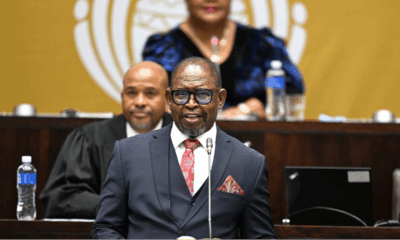
After months of tight fiscal talk and economic nerves, South Africa’s currency strengthened following the release of the 2026 national budget by Finance Minister Enoch Godongwana. By Wednesday afternoon, the rand was trading at R15.8550 to the dollar, roughly 0.8% stronger on the day. By Thursday morning, it was hovering around R15.84 to the dollar, R21.47 to the pound and R18.72 to the euro.
On the Johannesburg Stock Exchange, the Top 40 index climbed 1.7%, reflecting renewed investor confidence. Gold was priced at $5,192.62 per ounce, and oil edged up to $71.09 per barrel, painting a broader picture of shifting global and local market forces.
A budget built on credibility
Godongwana’s message was clear: fiscal discipline remains the order of the day.
Rather than pinning public finances to a strict numerical ceiling, the National Treasury plans to introduce what it calls a principles-led fiscal anchor later this year. Analysts say this signals a continued commitment to stabilising debt and restoring long-term sustainability. Treasury reiterated that it aims to see the debt-to-GDP ratio peak in the current fiscal year before beginning to decline.
Over the past year, investors have been watching closely for signs that reform promises are translating into action. Market reaction suggests that many believe progress is finally taking shape. Reform momentum, cautious spending and an emphasis on institutional credibility appear to be resonating.
Locally focused traders will now turn to producer price inflation data, as well as money supply, private sector credit, trade balance and budget balance figures due later this week. The mood remains cautiously optimistic.
Government trims thousands of jobs
Behind the market gains lies a more sobering reality for the public sector.
National Treasury has accelerated its Early Retirement Programme, which officially began in October 2025. So far, 7,687 applications have been approved, with R3.7 billion already allocated to fund these exits. In his budget speech, Godongwana added a further R340 million to support the initiative.
The programme is designed to refresh the public service, reduce long-term wage pressures and bring in younger employees. Supporters argue it could improve efficiency and ease strain on state finances. Critics worry about institutional memory and whether departments can maintain service delivery during the transition.
For many South Africans, the numbers are not abstract. They represent colleagues, neighbours and family members navigating an uncertain next chapter.
Online gambling faces fresh tax pressure
Another headline-grabbing move is the Treasury’s plan to introduce a 20% tax on online gambling operators.
The Free Market Foundation has raised concerns, warning that the industry is already heavily taxed. Policy officer Ayanda Zulu told 702 that offshore casinos account for 62% of all online gambling activity. He argued that the regulation of offshore operators should take priority before imposing additional taxes on local players.
On social media, reactions have been mixed. Some users welcomed tougher oversight in a fast-growing digital sector, while others questioned whether higher taxes could drive more gamblers towards unregulated platforms.
Online betting has surged in popularity in recent years, especially among younger South Africans who access platforms via mobile apps. Any policy shift is likely to ripple quickly across the market.
Billions set aside for elections
The 2026 budget also allocates R1.116 billion to fund this year’s local government elections through a dedicated allocation to the Electoral Commission of South Africa. The funds are ring-fenced strictly for election-related activities.
In a country where coalition politics and municipal performance are under intense scrutiny, the elections are expected to be closely contested. Ensuring proper funding is essential for credibility and smooth administration.
Eskom may step into struggling municipalities
The National Treasury has recommended that 15 struggling municipalities appoint Eskom as their electricity distribution agent under Distribution Agency Agreements.
If implemented, Eskom would take control of electricity infrastructure management, billing and collections. Payments from consumers would go directly into Eskom’s bank account.
The proposal reflects ongoing concerns about municipal debt, infrastructure decay and revenue collection failures. For residents frustrated by unreliable power and billing disputes, the move could be seen as a necessary intervention. For others, it raises questions about local autonomy and governance.
A balancing act for 2026
Taken together, the 2026 budget sketches a picture of a government trying to steady the ship. It promises fiscal consolidation and reform, even as it navigates sensitive terrain such as public sector jobs and new taxes.
The stronger rand suggests markets are cautiously convinced. Whether ordinary South Africans feel the same confidence will depend on how these policies play out in daily life, from municipal electricity services to the cost of living and job security.
For now, the currency has rallied. The real test will be whether the reform story holds.
Follow Joburg ETC on Facebook, Twitter, TikT
For more News in Johannesburg, visit joburgetc.com
Source: Business Tech
Featured Image: cipro.co.za