News
“What’s the point of studying?”: KZN teachers take their fight for jobs to the streets
“What’s the point of studying?”: KZN teachers take their fight for jobs to the streets
Dreams parked outside government offices
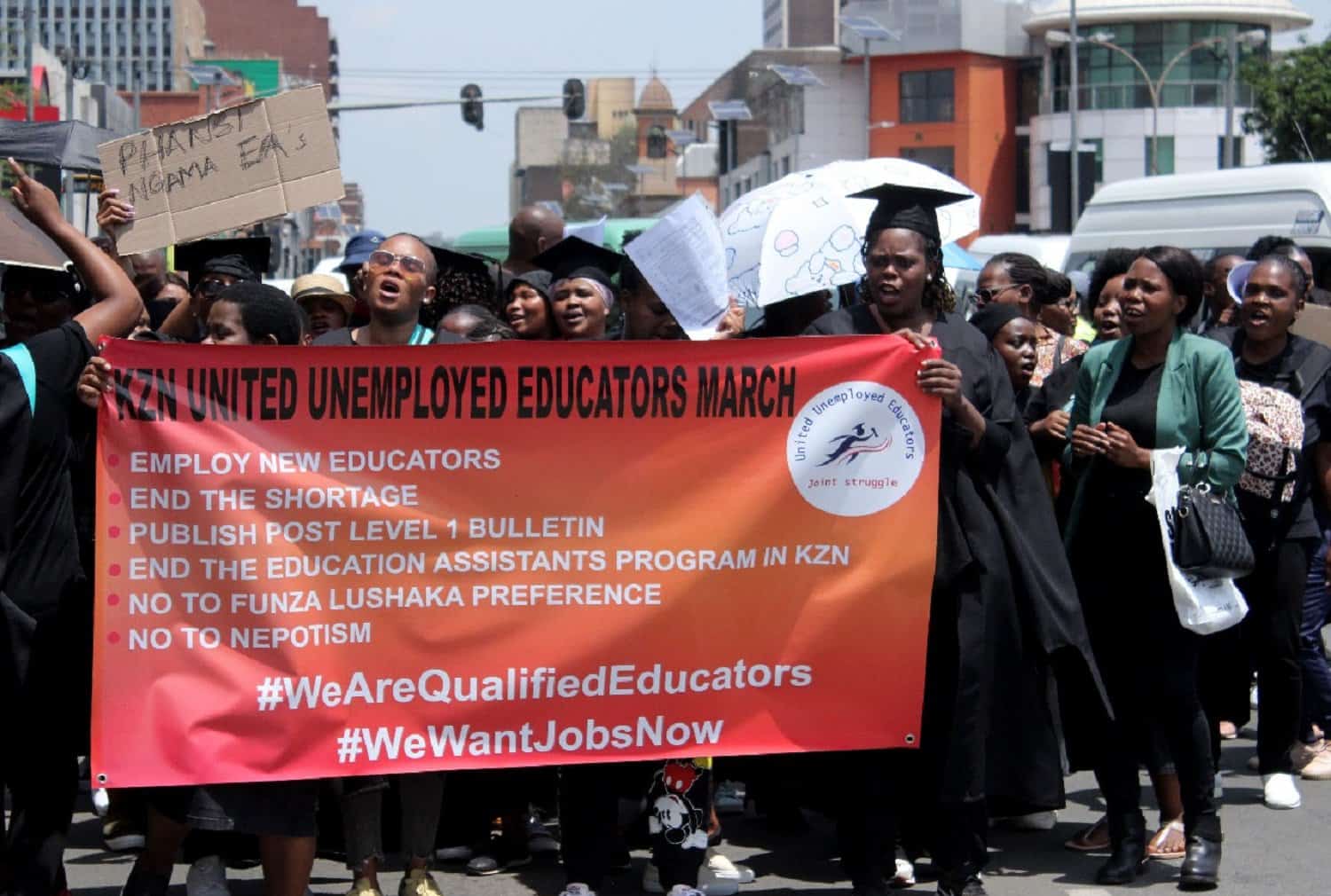
On any given day in Pietermaritzburg’s CBD, Langalibalele Street is busy with taxis, commuters, and the usual rush of city life. But this week, something different unfolded.
A group of teachers qualified, determined, and deeply frustrated took to the streets, disrupting traffic and marching with a question that cut straight to the heart of South Africa’s education crisis:
What is the point of studying if you still can’t find work?
Outside the KwaZulu-Natal Department of Education offices, some of them have gone even further camping day and night, hoping that simply being seen might finally lead to being heard.
A lifelong dream slipping away
For Zilungile Malinga, teaching wasn’t just a career choice. It was a dream she carried through hardship.
Now 55, she stands just five years away from retirement without ever having had a permanent teaching job.
She earned her Bachelor of Education through University of South Africa in 2019. Since then, she says, it’s been rejection after rejection.
Her story is one of resilience. As a young girl, she sold grass and made mud bricks just to stay in school. Later, she relied on National Student Financial Aid Scheme to finally access higher education.
But today, she faces a different kind of struggle explaining to her children why her qualifications haven’t translated into a job.
A generation waiting… and waiting
She’s not alone.
Younger graduates like Enhle Mngadi say they are already losing hope. At 32, she should be building her career. Instead, she travels repeatedly from Inanda to Pietermaritzburg, joining others who sit outside the department’s offices, waiting for a breakthrough.
Since January, she’s been sleeping there spending money she doesn’t have on food, clinging to the possibility that someone might finally take notice.
Then there’s Fisani Mthembu, who is approaching her late 40s with a degree, a teaching qualification, and mounting debt.
Her story highlights another layer of the crisis financial strain. With unpaid university fees and a family to support, she says the emotional toll of unemployment has been just as heavy as the economic one.
When education doesn’t guarantee opportunity
South Africa has long promoted education as the key to a better life. It’s a message repeated in classrooms, homes, and political speeches.
But for these teachers, that promise feels increasingly out of reach.
Despite applying for multiple posts sometimes more than seven in a single year many say they’ve never even been called for interviews.
And while the country faces ongoing challenges in schools, including overcrowding and teacher shortages in certain areas, the disconnect between qualified graduates and available posts remains glaring.
Social media reaction: anger, empathy, and frustration
Online, the protest has struck a nerve.
Many South Africans have expressed sympathy, sharing similar experiences of being qualified but unemployed. Others have questioned how a country can produce graduates it seemingly cannot absorb into the workforce.
Some comments have pointed to deeper structural issues from budget constraints to hiring processes while others have simply echoed the protesters’ central frustration: education should lead somewhere.
A uniquely South African contradiction
There’s a painful irony here.
In many rural and township communities, teachers are still seen as pillars of hope role models who prove that education can change lives.
Yet here are trained educators, sitting outside offices, waiting for the very system they believed in to work for them.
It’s a contradiction that speaks to broader issues in South Africa’s economy: high youth unemployment, limited public sector hiring, and a growing gap between qualifications and opportunity.
More than a protest a plea for dignity
What stands out most about this story isn’t just the unemployment figures. It’s the human cost.
The mothers who feel they’ve failed their children.
The graduates who feel invisible.
The families still waiting for the promise of education to pay off.
These are not just job seekers. They are people asking for dignity for a chance to use the skills they worked so hard to earn.
How long can hope last?
As the teachers continue their protest outside the department offices, one thing is clear they are not ready to give up.
But time is not on everyone’s side.
For some, like Malinga, the window is closing. For others, like Mngadi, the fear is that it may never open at all.
And for a country that has long told its young people that education is the answer, their question lingers in the air:
If not this, then what?
{Source: IOL}
Follow Joburg ETC on Facebook, Twitter , TikTok and Instagram
For more News in Johannesburg, visit joburgetc.com