Business
Eskom’s R320 billion overhaul could change South Africa’s power future
A turning point hiding in plain sight
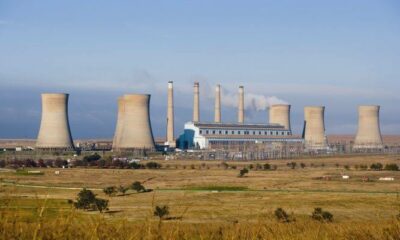
South Africa’s biggest infrastructure announcement of the year is not flashy, fast, or guaranteed to succeed. But it is massive. Eskom’s newly announced R320 billion infrastructure overhaul now stands as the single largest project on the country’s 2025 capital expenditure list, and it tells a deeper story about where South Africa is trying to go and what still stands in the way.
The project forms part of a broader surge in fixed investment plans, with 27 new mega projects worth a combined R705.6 billion announced over the past year. According to Nedbank’s latest Capital Expenditure Project Listing, planned fixed investment for 2025 is up 16.4 percent year on year. Most of that momentum is coming from the private sector, not the government.
Yet Eskom, a public corporation with a complicated legacy, dominates the picture.
Why Eskom’s plan matters more than the headline number
Eskom’s five-year infrastructure overhaul accounts for 45.3 percent of the total value of all new projects announced for 2025. Within the electricity, gas, and water sector, it represents a staggering 77 percent of planned investment.
The funding is spread across three critical areas. Around R139.5 billion is earmarked for electricity generation, R132 billion for expanding and strengthening transmission networks, and R44 billion for upgrading distribution infrastructure.
This is not just about keeping the lights on. Eskom’s plan is designed to stabilise the grid while also making space for a more diverse energy mix. Expanding transmission capacity is particularly important if South Africa is serious about integrating more renewable energy into the system, something the private sector has been pushing for years.
Energy dominates as private investment surges
The electricity, gas, and water sector leads all investment plans, with projects worth R415.6 billion. That is nearly 60 percent of the total value of new announcements.
Nedbank points to three clear trends driving this surge: a resurgence in private sector confidence, the dominance of energy-related projects, and a widening gap between public corporations and direct government investment.
Private sector project announcements more than tripled, jumping from R116.2 billion in 2024 to R382.5 billion in 2025. Improved macroeconomic conditions have played a role, including lower inflation, a stronger rand, and South Africa’s exit from the grey list. Together, these factors have reduced some of the barriers that previously kept investors on the sidelines.
Among private players, Vodacom’s Vision 2030 programme stands out, with R85.2 billion committed to network upgrades and nationwide 5G expansion. MTN, Microsoft, mining firms, and renewable energy developers also feature prominently across the project list.
The quiet retreat of government spending
While public corporations like Eskom still carry weight, general government investment has dropped sharply. New government project announcements fell to just R2.9 billion in 2025, down from R204 billion the year before.
This is not because infrastructure needs have disappeared. Instead, the focus has shifted to execution. Many of the projects announced in 2024 have yet to break ground, particularly in energy, water, logistics, and municipal services.
Nedbank has warned that until visible progress is made on these fronts, private sector enthusiasm may remain cautious. High electricity and logistics costs continue to undermine competitiveness, and these pressures are felt daily by households and businesses alike.
Public reaction: cautious hope mixed with fatigue
On social media and in business circles, reaction to the Eskom announcement has been mixed. There is relief that grid expansion and maintenance are finally being prioritised at scale. There is also deep scepticism, shaped by years of delays, cost overruns, and broken promises.
For many South Africans, the question is not whether R320 billion is enough. It is whether the money will translate into real, measurable change. Fewer outages. Faster connections for renewables. Lower long-term costs.
What comes next for investment confidence
Looking ahead, Nedbank expects gross fixed capital formation to recover gradually, rising from negative growth in 2025 to around 2 percent in 2026, with modest gains thereafter. But risks remain. High operating costs, excess capacity in some sectors, global trade pressures, and uncertainty around reform continue to weigh on confidence.
Eskom’s overhaul is not a silver bullet. But it is a necessary foundation. If executed properly, it could lower energy costs, unlock private investment, and finally give South Africa’s energy transition the infrastructure it needs to move from ambition to reality.
For now, the country is watching. Carefully.
Follow Joburg ETC on Facebook, Twitter, TikT
For more News in Johannesburg, visit joburgetc.com
Source: Business Tech
Featured Image: BusinessTech