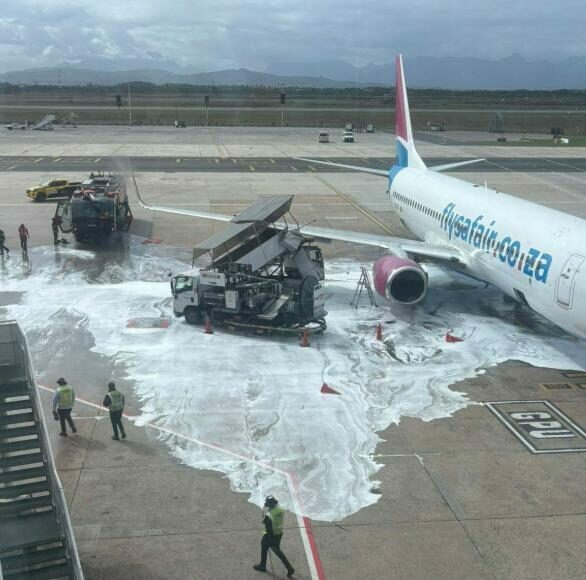
Travellers passing through Cape Town International Airport on Sunday morning were met with an unexpected moment of tension after a fuel leak involving an aircraft triggered an emergency response on the airside.
The incident unfolded around 11:00 on April 6, right in the thick of the Easter travel rush, one of the busiest periods on South Africa’s aviation calendar.
Emergency Teams Respond Within Minutes
Airport emergency crews moved quickly to contain the situation, securing the affected area and implementing standard safety procedures almost immediately.
According to Airports Company South Africa, the leak was classified as a ground handling incident rather than an in-flight emergency, meaning it was confined to operations on the ground.
Officials confirmed that the response was swift and controlled, with no injuries reported and no risk posed to passengers or airport staff.
Flights Continued Without Disruption
Despite the initial alarm, operations at the airport continued as normal.
Passengers were still able to check in, board flights and move through the terminal without delays linked to the incident. Authorities stressed that safety protocols worked exactly as intended, allowing the airport to remain fully functional.
Travellers have been encouraged to keep an eye on flight updates via official airport channels, especially as post-Easter travel volumes remain high.
A Reminder Of How Airports Manage Risk
While incidents like these can feel unsettling, they are not uncommon in complex aviation environments where aircraft are constantly being refuelled, serviced and prepared for departure.
What stands out in this case is how efficiently the situation was handled. Cape Town International has long been regarded as one of Africa’s leading airports, and its ability to respond without disrupting operations reinforces that reputation.
Global Travel Pressures Add Context
The incident also comes at a time when global travel has already been under strain.
Ongoing geopolitical tensions in the Middle East have recently disrupted major flight routes, particularly those relying on key transit hubs such as Dubai, Doha and Abu Dhabi. These disruptions have had a knock-on effect on South African airports, including Cape Town.
Against that backdrop, the seamless handling of Sunday’s fuel leak offers a measure of reassurance for travellers navigating an already unpredictable travel landscape.
Business As Usual At Cape Town’s Busiest Gateway
For most passengers, the incident passed without any real impact beyond a brief moment of concern.
And that, in many ways, is the point. Behind the scenes, aviation safety systems are designed to absorb shocks like these without affecting the traveller experience.
On a busy holiday weekend, that is exactly what happened in Cape Town.