News
‘Catastrophic Risk’: Fishing Communities, Green Groups Take on Total Energies in High Court Battle
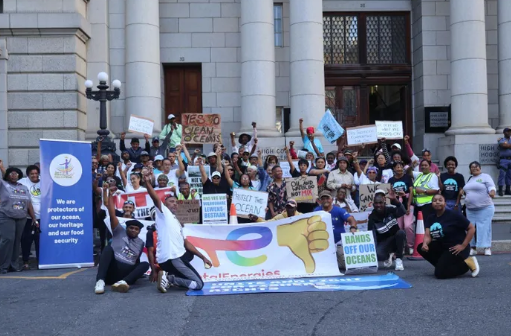
Judgment has been reserved in the Western Cape High Court in a mammoth environmental battle launched by applicants Aukotowa Fisheries Primary Co-operative Limited, The Green Connection NPC, and Natural Justice.
The applicants are challenging the environmental authorisation granted to Total Energies for ultra-deep-water oil and gas drilling in the Deep Western Orange Basin (DWOB) , located roughly 200 kilometres off the West Coast of South Africa.
The Parties
The applicants have gone head to head against:
-
The Director-General (DG) of the Department of Mineral and Petroleum Resources
-
The Minister of Forestry, Fisheries and the Environment
-
Total Energies EP South Africa (TEEPSA)
The Argument
The applicants argue that “there are predictable, long-term ecological impacts that go along with petroleum projects.”
At its core, the litigation argues that the approval process was:
-
Fatally flawed
-
Irrational
-
Inconsistent with the Constitution, the National Environmental Management Act (NEMA) , and South Africa’s climate and energy obligations
The case includes arguments about the impact of exploration on fishing communities and their livelihoods. They submit that the interests of a corporation are clearly prioritised above the rights of people living on the coastline.
The Oil Spill Risk
In their heads of argument, the applicants submitted that it is common cause that a major oil spill resulting from a “well blow-out” is the most significant risk arising from the exploration activities, and that this occurrence could correctly be described as “catastrophic.”
“Because the consequence of an oil spill would be the effective destruction of the marine environment for a sustained period, this risk has a bearing on multiple aspects of the impact assessment.”
The impact on marine ecology, commercial and small-scale fisheries, coastal and near-shore users, and intangible heritage was in every case estimated as “high” or “very high.”
The Relief Sought
The applicants have sought an order reviewing and setting aside both:
-
The Director-General’s decision to grant the environmental authorisation
-
The Minister’s decision to dismiss the applicants’ appeals
They are asking the court to take the rare step of a substitution order instead of sending the matter back to the department to try again, the court should itself issue an order refusing the authorisation.
“This is necessary to ensure that the environment and the rights of the fishers are protected from further unlawful administrative processes.”
Total Energies’ Response
Advocate Chris Loxton for TEEPSA chipped away at the applicants’ arguments, submitting that a distinction between exploration and production was made out in provisions of NEMA and the National Environmental Management: Integrated Coastal Management Act (ICMA) and that in that regard, there was compliance.
Loxton submitted that by complying with NEMA, the eventuality was that they complied with ICMA.
“The Applicants have not shown that there is any requirement of ICMA which was not in the course of complying with NEMA. They have not said, for example, that you were supposed to have done X and the consequence is Y.”
The Bottom Line
Judgment is reserved. The stakes are enormous.
For Total Energies, it’s a multi-billion-rand exploration project. For fishing communities, it’s their livelihoods and the health of the ocean. For environmental groups, it’s a test of whether South Africa’s climate and energy obligations mean anything in practice.
The court’s decision will shape the future of offshore oil and gas in South Africa.
{Source: IOL}
Follow Joburg ETC on Facebook, Twitter , TikTok and Instagram
For more News in Johannesburg, visit joburgetc.com