
News
The sacred drum taken in 1916 finally returns home to Ivory Coast
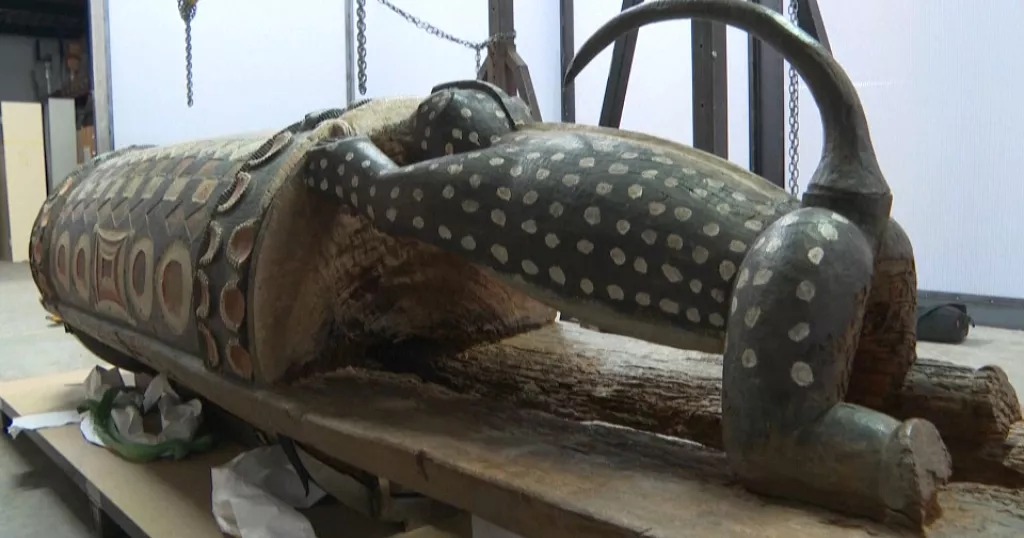
For more than a century, it sat in a museum thousands of kilometres from the land where its voice once echoed through forests and villages. Now, the Djidji Ayokwe has finally gone home.
France has officially returned the sacred talking drum to Ivory Coast, marking a powerful moment in the ongoing effort to restore African cultural treasures taken during colonial rule. The announcement was made by UNESCO, confirming the historic repatriation of an object that carries far more meaning than its carved wooden form suggests.
More than music: A symbol of power and resistance
The Djidji Ayokwe belonged to the Ebrie people, also known as the Atchan. It was not simply used for rhythm or celebration. This drum communicated. Its beats warned communities of danger, rallied people in times of conflict, and summoned villagers for major ceremonies. It was, in every sense, a voice of authority.
In 1916, French colonial troops confiscated the drum. The act was not random. It was part of a deliberate strategy to weaken resistance among the Atchan people during colonial rule. Removing the drum meant silencing a vital tool of mobilisation and unity.
By 1929, the drum had reached France. It was first housed at the Musée de l’Homme before being transferred in 2006 to the Quai Branly Jacques Chirac Museum in Paris, where it remained for nearly two decades.
An emotional handover in Paris
The formal ceremony took place at the Quai Branly Museum, attended by Ivory Coast’s Minister of Culture, Françoise Remarck, and France’s Minister of Culture, Rachida Dati.
Remarck spoke of a nation ready to receive what had long been missing. Dati described the moment as deeply symbolic, acknowledging the emotional weight of seeing the drum retrace its journey back to its homeland.
There was a sense that this was about more than one object. It was about acknowledgement.
A broader reckoning with history
The return of the Djidji Ayokwe forms part of a wider shift in France’s approach to colonial-era collections. In 2017, President Emmanuel Macron pledged to accelerate the restitution of African heritage held in French museums. Since then, steps have been taken to return several artefacts.
One of the most notable examples came in 2021, when France handed back 26 treasures taken from the royal palace of Abomey to Benin. Each return has added momentum to a growing conversation across Europe about ownership, memory, and justice.
UNESCO played a central role in facilitating the drum’s repatriation through its office in Abidjan. The organisation also allocated $100,000 to support preservation efforts and ensure the drum can be properly protected and displayed now that it has returned.
Why this moment matters
For many across Africa, the debate around looted artefacts is not just about museum displays. It is about identity, dignity, and history. Cultural objects like the Djidji Ayokwe are woven into the stories of communities. When they are removed, something intangible is lost alongside them.
The drum’s return signals an attempt to repair that rupture. It does not undo the past, but it does acknowledge it.
For Ivory Coast, however, this is a day of pride. The drum that once called people together in moments of urgency and ceremony will once again stand on home soil. Its voice, once silenced by force, has found its way back.
Follow Joburg ETC on Facebook, Twitter, TikT
For more News in Johannesburg, visit joburgetc.com
Source: IOL
Featured Image: Africa News


