News
Invisible Chains: How Human Trafficking Continues to Thrive in South Africa

A crime that hides in plain sight
Human trafficking in South Africa does not look like it does in the movies. There are no chains, no locked basements, no dramatic rescues playing out in public view. Instead, exploitation happens quietly, in homes, farms, factories, nightclubs and even online spaces, while traffickers continue to operate with remarkable freedom.
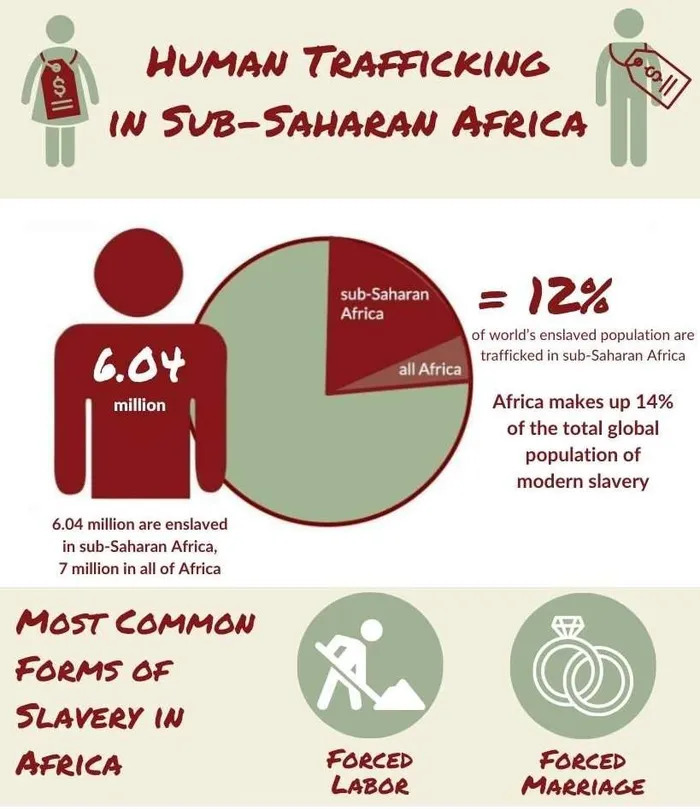
Researchers estimate that as many as 250,000 people may have been trafficked in South Africa, according to studies by the Human Sciences Research Council. The Global Slavery Index places around 155,000 people in conditions of modern slavery, including forced labour, sexual exploitation and domestic servitude. Yet only a fraction of these cases ever surface.
That gap between reality and official records is where the crisis truly lies.
Sourced: IOL
Why South Africa is a trafficking hotspot
South Africa’s position as a regional economic hub makes it both an opportunity and a risk. The country is classified as a source, transit and destination for human trafficking. Victims are recruited locally, moved internally between provinces, and trafficked across borders into and out of the country.
Porous borders, high unemployment and deep inequality create ideal conditions for exploitation. For traffickers, the system is efficient: people can be recruited cheaply, controlled through fear or debt, and exploited repeatedly with little risk of prosecution.
False promises and digital recruitment
Modern trafficking rarely begins with violence. It begins with hope.
Victims are often lured by promises of legitimate work, education or love. Increasingly, recruitment happens through social media and messaging platforms, where fake job offers and online relationships feel trustworthy and personal.
The 2024 National Human Trafficking Hotline report highlighted cases where South Africans were promised lucrative call-centre or data-capturing jobs in countries like Thailand. Informal interviews conducted via WhatsApp video calls gave the illusion of legitimacy. Traffickers even covered passports, visas, flights and accommodation costs later used to trap victims in debt bondage.
By the time reality sets in, escape is no longer an option.

Sourced: IOL
Who is most at risk
While anyone can be trafficked, the data shows clear patterns. Research from Unisa indicates that women and children make up the majority of identified victims, although men are also trafficked, particularly for forced labour.
Hotline data paints an even starker picture:
-
94.5% of reported victims were women
-
61.8% of reported cases involved sexual exploitation
-
69.1% of victims were South African nationals
This challenges the widespread belief that trafficking mainly affects foreign nationals. While cross-border trafficking is real, involving victims from Mozambique, Zimbabwe, Malawi, Nigeria and the DRC, exploitation is very much a local crisis.
Children remain especially vulnerable, often experiencing multiple forms of abuse throughout the trafficking process. As UKZN’s Dr Monique Emser has warned, reducing child vulnerability requires far greater attention and intervention.
Cities, routes and hidden workplaces
Trafficking thrives where movement and anonymity intersect. Major urban centres such as Johannesburg, Cape Town and Durban consistently appear as hotspots, linked to transport routes, informal labour markets and high demand for cheap or coerced labour.
Victims are exploited in agriculture, construction, domestic work, informal trading and the sex trade, sectors that are notoriously difficult to regulate and inspect. What looks like ordinary economic activity often masks deep abuse.
Linked to bigger criminal networks
Human trafficking does not operate in isolation. Experts say it overlaps seamlessly with organised crime, gender-based violence, missing persons cases, irregular migration and labour disputes.
A USAID report described trafficking in South Africa as “systemic”, embedded within broader criminal and social systems. This makes dismantling networks far more complex than arresting individual offenders.
Why convictions remain rare
Perhaps the most disturbing statistic is this: between 2007 and 2022, only 77 traffickers were convicted in South Africa.
This is despite strong legislation under the Prevention and Combating of Trafficking in Persons Act. The problem lies in implementation. Investigations are complex, victims are terrified to testify, evidence is hard to collect, and coordination between agencies often fails.
Weak data systems and limited specialist capacity within law enforcement further obscure the true scale of the crime. International watchdogs, including the US Trafficking in Persons Report, have repeatedly noted that South Africa still falls short of fully meeting minimum anti-trafficking standards.
The real cost of hidden slavery
Human trafficking is not only a human rights disaster it is an economic one. It undermines labour protections, distorts markets, burdens social services and erodes trust in the state’s ability to protect its most vulnerable citizens.
Like illicit cigarettes or illegal alcohol, trafficking thrives because it is profitable, adaptable and low-risk for criminals.
Until detection improves, convictions increase and economic vulnerability is meaningfully addressed, trafficking will continue to flourish, quietly, invisibly, and devastatingly in communities across South Africa.
{Source: IOL}
Follow Joburg ETC on Facebook, Twitter , TikTok and Instagram
For more News in Johannesburg, visit joburgetc.com