News
Joburg communities turn crisis into care as residents build their own water lifeline
Joburg communities turn crisis into care as residents build their own water lifeline
When the taps run dry, neighbours step in
In Johannesburg’s southern suburbs, water outages have become part of daily life disruptive, unpredictable, and increasingly difficult to ignore.
While protests over failing supply systems have made headlines, something quieter but more powerful has been unfolding in neighbourhoods like Ridgeway: residents are building their own survival systems.
Not with policy or press conferences, but with hoses, tankers, and a shared understanding that waiting for solutions is no longer enough.
A grassroots system built from frustration and faith in community
At the centre of this effort is community organiser Zubair Patel, who founded the Southern Suburbs Community Forum and Water Project after noticing how disconnected neighbourhood life had become.
What began as a small local forum three decades ago has since grown into a lifeline network spanning more than 100 homes across 15 suburbs in southern Johannesburg.
The idea is simple: residents with boreholes share water with those affected during municipal outages.
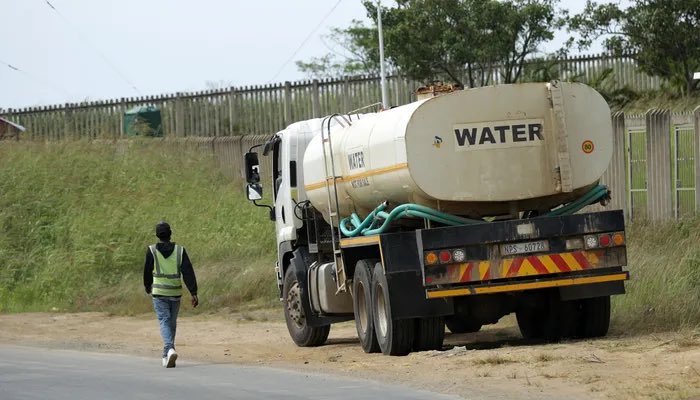
A mobile 1 000-litre tanker now moves through the area, filling up at participating homes and distributing water where it’s needed most especially during prolonged shortages.
A message on the side of the tanker captures the spirit of the initiative:
“The best form of charity is to give someone water.”
From private boreholes to public lifelines
The system took a major step forward in 2022, after an extended outage exposed just how vulnerable many households were.
From that moment, the informal sharing arrangement evolved into a structured network. Homeowners who had access to boreholes voluntarily signed up, turning private resources into a shared community safety net.
But the real turning point came a year later.
Elderly residents and people living with illness began struggling to collect water themselves. That gap forced the community to adapt again this time introducing a door-to-door delivery system.
What started as neighbourly help quickly became a coordinated volunteer operation.
The volunteers who keep the system moving
In Ridgeway, the process now runs with surprising precision.
A list of households in need is drawn up. Volunteers then set off with a bakkie and a tanker, delivering water directly to those who cannot make the journey themselves.
At one stop, a young mother waits outside a low-cost housing complex with her children, holding empty buckets. For families like hers, long walks across suburbs to collect water are not always possible.
Twelve-year-old volunteer Ismail Tayob steps forward to help fill her containers part of a growing network of residents who have turned crisis response into routine service.
The weight of the water alone around 20 kilograms is carried home in shifts.
A system that runs from dawn to midnight
The work doesn’t end when the sun goes down.
Volunteer teams often continue deliveries late into the night, sometimes returning just before midnight after checking storage tanks at places like the Annie Burger retirement village, where donated tanks help support elderly residents.
Every contribution matters. One resident offers a vehicle, another donates storage space, others give time. Slowly, a fragmented system has become a functioning community operation.
Living through uncertainty, hour by hour
For many households, the impact of water shortages is deeply personal.
In the south of Johannesburg, resident Yusra Domingo begins her day before sunrise, boiling water so her children can bathe before school. She is also managing stage three liver cancer, making physical tasks like carrying water impossible on most days.
Her reality reflects a wider truth in the city: water insecurity doesn’t affect everyone equally. Those already facing health or mobility challenges are often hit the hardest.
Beyond protest: a culture of community repair
Johannesburg’s water crisis has sparked protests and growing frustration across the city. But in these southern suburbs, another response is taking shape one rooted in cooperation rather than confrontation.
This is not a replacement for municipal service delivery. Residents are clear about that. Instead, it is a stopgap born out of necessity a way to ensure that no one is left completely without access to water.
The initiative also reflects something deeper about local life in South Africa: when formal systems struggle, communities often step in to bridge the gap.
A city held together by informal resilience
As uncertainty over water supply continues across Johannesburg, the southern suburbs are showing what collective action can look like at street level.
It is not perfect, and it is not permanent. But for now, it works.
And in a city where running water can no longer be taken for granted, that makes all the difference.
{Source: The Citizen}
Follow Joburg ETC on Facebook, Twitter , TikTok and Instagram
For more News in Johannesburg, visit joburgetc.com