Johannesburg residents complain about strange “rotten egg” smell in the air
For many residents across Johannesburg, the past few days have come with an unpleasant surprise: a lingering smell in the air that many people say is hard to ignore.
Since the weekend, social media platforms have been flooded with posts from people asking the same question: What is that smell?
Across neighbourhoods in the city, residents have described a persistent odour that resembles rotten eggs an aroma commonly associated with sulphur gases. While no official single source has been confirmed for the latest complaints, the incident has reignited concerns about air pollution in Gauteng.
Social media lights up with complaints
Residents from different parts of Johannesburg began posting about the smell over the weekend.
Some said they first noticed it early in the morning, while others claimed the odour became stronger late at night or during cooler hours. Many described it as sharp, sulphur-like and difficult to ignore.
On local community forums and X (formerly Twitter), the reactions ranged from confusion to frustration.
Some residents joked about the city’s “mystery smell,” while others raised serious concerns about whether the air might be harmful to breathe.
The complaints also revived a familiar debate about environmental conditions in Gauteng a province long associated with heavy industry and poor air quality.
Johannesburg’s long-standing air pollution problem
Concerns about the smell come against the backdrop of Johannesburg’s already strained air quality.
According to the Centre for Research on Energy and Clean Air, pollution linked to tiny airborne particles contributes to roughly 16,000 deaths each year in Gauteng.
These particles, known as PM2.5 and PM10, are small enough to enter the lungs and bloodstream, potentially contributing to respiratory illness, heart disease and other long-term health problems.
Monitoring data from the Department of Forestry, Fisheries and the Environment has shown that parts of the city regularly experience elevated pollution levels.
One air-quality sensor located in Jabavu has recorded average daily PM2.5 levels exceeding 300 micrograms per cubic metre at times far above the 75 micrograms per cubic metre daily guideline recommended by the World Health Organization.
Those figures highlight just how severe the region’s pollution problem can become under certain conditions.
Where could the smell be coming from?
Although the exact cause of the current odour complaints has not been confirmed, similar episodes have occurred before.
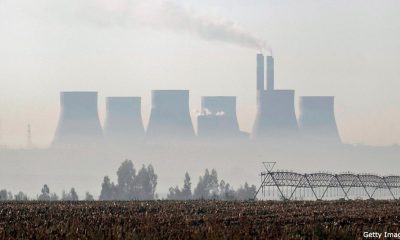
Earlier this year, the City of Johannesburg explained that previous sulphur-like smells were linked to polluted air drifting into Gauteng from the Highveld Priority Area.
This region, which stretches across parts of Mpumalanga, is home to numerous coal-fired power stations and petrochemical facilities.
Under certain atmospheric conditions particularly during the late summer months pollutants from those industrial zones can travel hundreds of kilometres.
Weather patterns between January and March sometimes allow polluted air masses to move across provinces and settle over Johannesburg.
When that happens, residents may notice unusual odours or hazy conditions.
What residents should do during pollution spikes
While authorities continue monitoring the situation, residents are being encouraged to take simple precautions when air quality deteriorates.
Officials recommend limiting outdoor activity during periods when pollution levels appear high or when strong odours are present.
People with respiratory conditions such as asthma may be especially sensitive to poor air quality and are advised to remain indoors where possible until conditions improve.
A reminder of the region’s environmental challenge
For many Johannesburg residents, the mysterious smell is more than just a nuisance.
It serves as another reminder of the environmental pressures facing Gauteng’s urban centres where heavy industry, power generation and dense traffic all contribute to declining air quality.
While the odour may eventually disappear as weather conditions shift, the broader conversation about pollution in South Africa’s economic heartland is unlikely to fade anytime soon.
For now, one question continues circulating online: Can you smell it too?