News
March and March leader says she will hand herself over as police move to lay charges
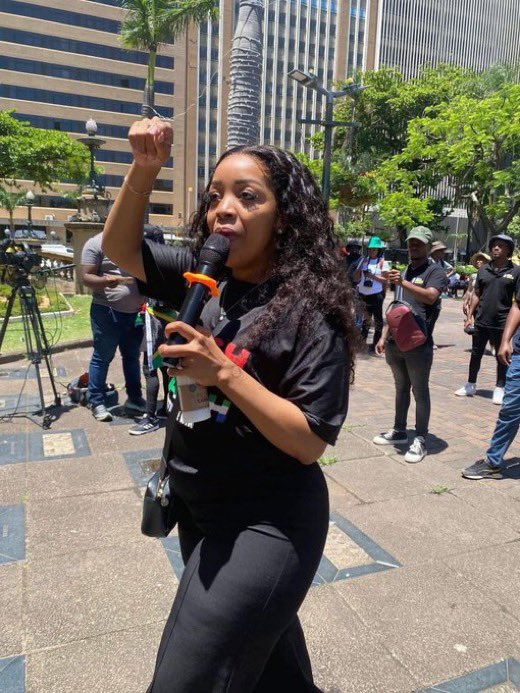
March and March leader says she will hand herself over as police move to lay charges
The political temperature in Durban rose sharply on Monday after the March and March Movement announced that its leader and founder, Jacinta Ngobese-Zuma, intends to hand herself over to police, amid reports that the South African Police Service (SAPS) is preparing to criminally charge her.
According to the movement, Ngobese-Zuma faces imminent arrest on allegations of inciting public violence during protests against undocumented foreign nationals claims that the organisation says are both unjust and politically motivated.
“Interesting news” from police
In a statement, March and March said it had received what it described as “interesting news” that police had decided to move ahead with criminal charges against its leader.
The movement framed the development as part of a broader crackdown on citizens who, it says, are raising legitimate concerns about marginalisation and inequality.
“We note the attitude of the State towards South African citizens who are merely fighting for the rights of the disenfranchised and downtrodden people of South Africa,” the statement read.
Ngobese-Zuma is expected to present herself at a police station on Tuesday morning, where she will be formally charged and appear in court.
“Our leader is a law-abiding citizen,” the movement said, adding that she would cooperate fully with the legal process.
Protests that put Durban in the spotlight
The reported charges stem from a series of high-profile protests outside Addington Primary School in Durban, which have drawn intense public attention and heavy police deployment.
March and March has repeatedly objected to what it claims is the admission of undocumented foreign nationals at the school, arguing that this undermines the rights of South African learners.
Education authorities and civil society organisations have strongly criticised the demonstrations, warning that they risk inflaming xenophobic tensions and disrupting schooling. The movement, however, insists the protests were peaceful and focused on accountability rather than violence.
On social media, the protests and Ngobese-Zuma herself have divided opinion. Supporters see her as a voice for frustrated communities, while critics accuse the movement of targeting vulnerable groups under the banner of activism.
Claims of selective policing
March and March also accused authorities of selective law enforcement, claiming that ordinary citizens are being targeted while serious criminal activity continues unchecked.
“It is easy to arrest and abuse voters and taxpayers,” the movement said, “while foreign nationals who are here illegally continue to sell drugs and illicit goods unabated.”
These claims echo a wider national debate around immigration, policing and service delivery, issues that have become flashpoints in many urban communities, particularly in KwaZulu-Natal.
Defiant tone despite legal pressure
Despite the looming legal action, the movement struck a defiant note, warning what it described as “apartheid apologists” that its campaign would continue.
For now, attention turns to Tuesday, when Ngobese-Zuma is expected to walk into a police station voluntarily, a move that her supporters view as principled, and her critics see as overdue accountability.
As the case unfolds, it is likely to test the fine line between protest, politics and public order in a country still wrestling with deep social and economic fault lines.
{Source: IOL}
Follow Joburg ETC on Facebook, Twitter , TikTok and Instagram
For more News in Johannesburg, visit joburgetc.com