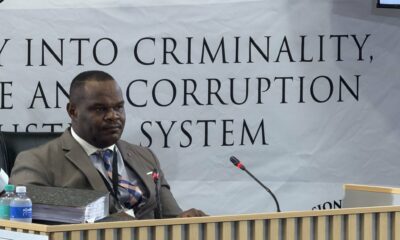
The press conference in July 2025 was extraordinary. A sitting provincial police commissioner, one of the most respected voices in South African law enforcement, stood before cameras and aired concerns about his own minister. It was the kind of public breach that policing institutions spend decades trying to avoid. But according to Nhlanhla Mkhwanazi, he had no alternative.
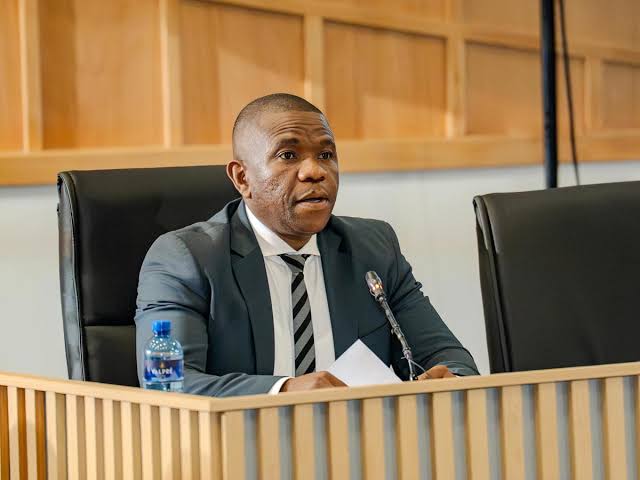
Testifying before Parliament’s Ad Hoc Committee on Wednesday, the KwaZulu-Natal Police Commissioner detailed the events that led to that moment. His unsuccessful attempts to engage the executive over directives issued by suspended Police Minister Senzo Mchunu, he said, left him with only one option: go public.
“I tried to engage the National Commissioner to raise my concerns and get the minister to sit around the table,” Mkhwanazi told the committee.
The directives in question were issued by Mchunu in December 2024. They ordered the disbandment of the Political Killings Task Team, a unit that had been investigating politically motivated murders in KwaZulu-Natal. They also placed a moratorium on filling vacancies within Crime Intelligencewithout consulting National Commissioner Fannie Masemola.
For Mkhwanazi, who had been at the forefront of the political killings investigations, the directives were not just administrative decisions. They struck at the heart of work he considered critical.
The Engagement That Failed
Mkhwanazi did not simply accept the directives quietly. He reached out. He tried to engage Mchunu directly. He sought a meeting where concerns could be raised, evidence presented, and decisions reconsidered.
The minister, according to Mkhwanazi, dismissed his concerns.
Mkhwanazi also reached out to Police Portfolio Committee Chairperson Ian Cameron, hoping to appear before the committee. A meeting was scheduled for February but could not proceed. The avenues for internal resolution were closing.
“It was my last option to say there are other arms of government and all three of them are appointed by the people of this country,” Mkhwanazi explained.
The “other arms” meant Parliament, the executive, and the judiciaryseparate branches with oversight roles. If the minister would not listen, perhaps the people’s representatives would.
But time was running out. A report had been prepared for a meeting with President Cyril Ramaphosa, but Mkhwanazi felt he could not delay. “When I addressed the nation, it was important to present the content. We could not wait anymore.”
The Allegations
Mkhwanazi’s testimony went far beyond process complaints. He stood by his earlier evidence about the infiltration of the criminal justice system by drug cartels and criminal syndicates.
“Senior members of the security cluster, associated with syndicates, issued instructions without the authority of the National Commissioner,” he said, referring specifically to suspended Deputy National Commissioner Shadrack Sibiya, who ordered that Political Killings Task Team dockets be moved from KwaZulu-Natal to head offices.
The movement of dockets is not a trivial administrative matter. It removes cases from the investigators who know them best, disrupts ongoing work, and can effectively kill investigations that powerful people want buried.
Mkhwanazi also alleged a “potentially corrupt relationship” between North West businessman Brown Mogotsi and Mchunu. He extended that allegation to include businessman Vusimuzi “Cat” Matlala, who was awarded a R360 million health care contract by the police.
The mention of Matlala is significant. He has been linked in previous testimony to organised crime and alleged cartel activity. A contract of that size, awarded to someone with such connections, raises obvious questions about procurement integrity and police oversight.
The Political Capture
Mkhwanazi’s testimony painted a picture of political capturenot just of individuals, but of institutions. He named names: Mchunu, National Coloured Congress leader Fadiel Adams, DA MP Dianne Kohler-Barnard.
“I must indicate that our leaders of society, who are the politicians, might not necessarily be involved with bad things at the beginning but because of corrupt members within, they capture these leaders and use them to the extent that a leader is used and becomes aware, but continues doing the wrong.”
This is a nuanced and important distinction. Politicians may start with good intentions. They may be fed information, cultivated by corrupt officials, drawn into networks of influence. At some point, they become awareand then they face a choice. Some pull back. Others, Mkhwanazi suggested, “find joy and go with it.”
He was explicit about Mchunu: “I still believe and I am convinced that Minister Mchunu was used, to do what he did.”
The directive to disband the Political Killings Task Team, in this reading, was not born of policy disagreement. It was the product of capturea minister acting on behalf of interests that wanted those investigations stopped.
The Intelligence Dimension
Mkhwanazi alleged that Adams used potentially classified information from Crime Intelligence to register cases against the unit’s officers. This raises a disturbing possibility: that the intelligence apparatus, meant to gather information on criminals, was being weaponised against the very officers investigating them.
He also claimed that unnamed prosecutors were part of a crime syndicate that included other law enforcement agencies, metro police, SAPS, and the judiciaryall controlled by drug cartels and businesspeople.
“It is known who some of them are, but we could not share because there are investigations. We named some politicians that are part of this.”
The existence of investigations provides both cover and constraint. It means the information cannot yet be made public. It also means that the allegations are serious enough to warrant formal inquiry.
The Security Clearance Question
In a striking admission, Mkhwanazi confirmed that he has had no security clearance since it expired in 2018. His 2022 application remains incomplete because there are pending criminal cases against him.
One case involves an investigation by the Investigative Directorate Against Corruption. Another involves alleged interference in a criminal case. A third involves an alleged hijacking being probed by IPID.
For a police commissioner, the lack of security clearance is extraordinary. It means he has not been vetted to the highest level while serving in one of the most sensitive positions in law enforcement. The pending cases against him complicate his testimony and provide ammunition for those who would discredit him.
But they do not, in themselves, disprove his allegations. A commissioner with cases against him can still be telling the truth about threats to the criminal justice system.
The Parliamentary Response
The Ad Hoc Committee listened intently. Members will have to weigh Mkhwanazi’s credibility against the seriousness of his allegations. They will have to consider the pending cases, the expired clearance, and the possibility that a commissioner under a cloud might have motives beyond public interest.
But they will also have to consider the pattern: a task team investigating political killings is disbanded. Dockets are moved. A minister issues directives without consulting the National Commissioner. Businessmen with alleged cartel connections win massive police contracts. Prosecutors are allegedly compromised. Intelligence is weaponised against investigators.
The pattern, if true, describes a criminal justice system not just under threat, but actively captured.
What Comes Next
Mkhwanazi’s testimony adds to a growing body of evidence before the committee. Other witnesses have made related allegations. The committee must now determine what is credible, what requires further investigation, and what should be referred to prosecutorial authorities.
For Mchunu, the allegations are damaging. He is already suspended. If the committee finds substance in Mkhwanazi’s claims, his position becomes even more precarious.
For Mkhwanazi, the testimony carries risk. He has publicly accused a minister, named politicians, and described systemic capture. Those with power to retaliate may do so.
But he presented his actions as necessaryforced by a minister who would not listen, by a system that offered no other avenue, by a situation that could not wait.
“He left me no choice,” Mkhwanazi said. The committee must now decide what to do with the choice he made.