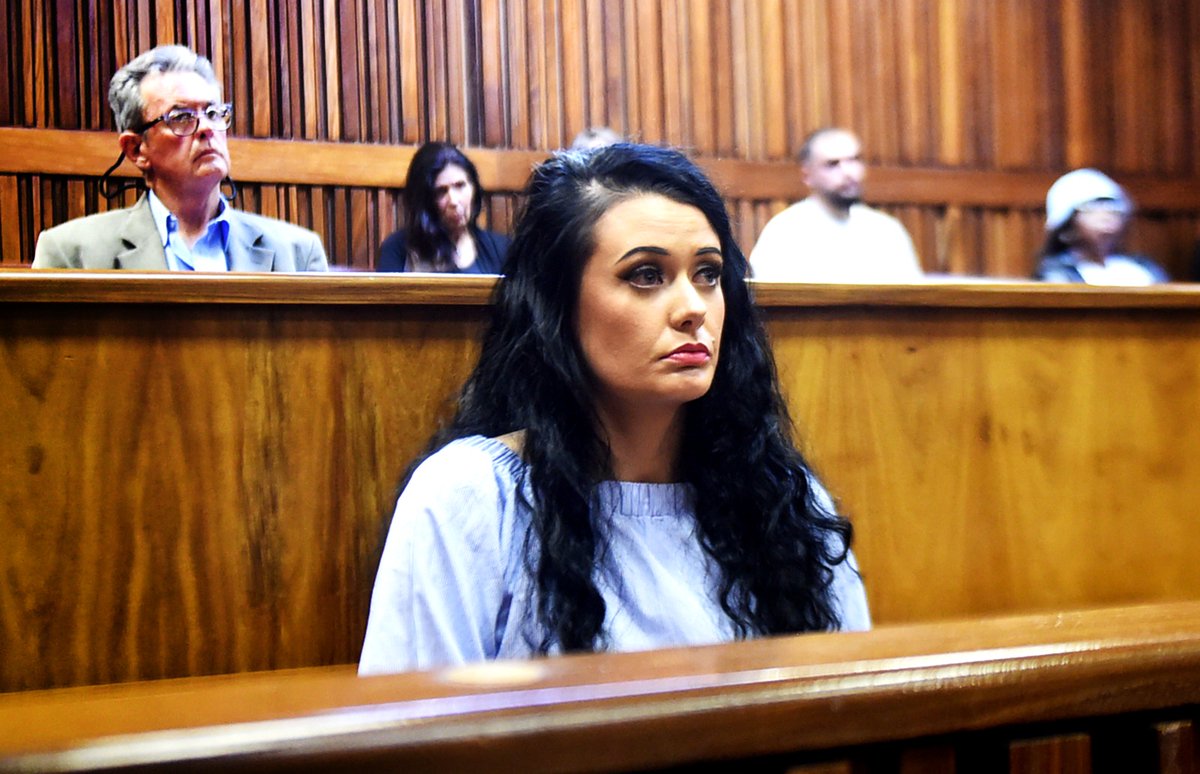
Birthday behind bars: Amber-Lee Hughes grilled in court over child murder case
A celebration that turned into cross-examination
There were no candles. No cake. No birthday wishes echoing through a living room.
Instead, Amber-Lee Hughes marked her 27th birthday seated in the dock at the Gauteng High Court, facing sharp questions about the murder of four-year-old Nada-Jane Challita.
It was the fourth day of her pre-sentencing proceedings and her second day on the stand.
The courtroom atmosphere was tense. Prosecutor Rolene Barnard methodically worked through a trail of text messages exchanged between Hughes and Nada-Jane’s father, Ellie Challita. At the heart of it all was a question that seemed to hang in the air: which version of Hughes should the court believe?
The affectionate girlfriend in the messages?
Or the woman now portraying a negligent, even abusive, father?
Text messages under the microscope
The State zeroed in on messages that painted a very different picture from the one Hughes offered in court.
In the texts, she appeared warm, supportive even admiring. At one point, she reassured Ellie that if anyone asked her or her assistant about him, they would have “nothing but positive things to say.”
Yet on the stand, Hughes described a struggling single father who failed to care properly for his daughter. She claimed she had exaggerated praise in order to preserve their relationship.
“I only complimented him because he was by himself,” she told the court, suggesting her supportive tone was less about truth and more about keeping peace.
For the prosecution, the contradiction was critical. If she believed Nada-Jane was unsafe, why present a picture of stability and support in writing?
Barnard pressed her: were her actions truly in the child’s best interests or were they aimed at securing her place in the father’s life?
“I was saving her”
Despite having previously admitted to killing the child, Hughes told the court she believed she was protecting Nada-Jane.
She testified that she had sacrificed everything for both father and daughter, and that without her presence the little girl would have been neglected. In a striking claim, she said she believed she was “saving” the child from ongoing harm and had even contemplated taking her own life.
It’s a defence rooted in desperation, one that now forms part of the court’s consideration as it weighs sentence.
But outside the courtroom, public reaction has been far less sympathetic.
Public reaction: outrage and heartbreak
Since January 2023, when the tragedy first unfolded, the case has gripped South Africans. Social media platforms have filled with grief for Nada-Jane and anger at the circumstances that led to her death.
Many online commentators have questioned how a child welfare system already stretched thin could have failed to prevent such an outcome. Others have pushed back strongly against Hughes’ portrayal of events, arguing that text messages suggesting affection and stability contradict her claims of rescue and sacrifice.
In a country where cases of violence against women and children dominate headlines with disturbing regularity, this trial has reopened deep wounds.
The mental health factor
Earlier in the week, Hughes told the court she struggles with bipolar disorder and depression. She said financial constraints sometimes forced her to stop taking medication.
Mental health is likely to feature prominently in sentencing arguments. South African courts have, in past cases, weighed psychological conditions as mitigating factors, but rarely as justification.
The broader conversation here is uncomfortable but necessary. South Africa’s public healthcare system often leaves psychiatric patients navigating inconsistent treatment and medication shortages. However, legal experts point out that mental illness alone does not absolve criminal responsibility, particularly in cases involving vulnerable children.
The missing history
What makes this case particularly complex is the relationship dynamic.
Hughes and Ellie Challita were involved in what has been described as a turbulent relationship. Nada-Jane was in Hughes’ care at the time of her death. Hughes has claimed that social workers had previously removed the child from school on several occasions, raising questions about prior welfare concerns.
But the central fact remains unchanged: a four-year-old girl lost her life.
That is the weight hanging over these proceedings.
What happens next?
Hughes is expected to face further questioning from her own legal team as the pre-sentencing phase continues. The court must now consider aggravating and mitigating factors, from the brutality of the crime to her mental health claims and expressions of remorse.
Birthdays are meant to mark growth, reflection, and hope for the year ahead.
For Amber-Lee Hughes, this one marked something else entirely, a public reckoning inside a Johannesburg courtroom, where every word is measured against the memory of a child who never got to grow up.