Power & Utilities
Johannesburg water crisis deepens as Pemmy Majodina attends AU Summit in Ethiopia
Joburg runs dry while minister attends AU summit in Ethiopia
Johannesburg residents are counting water drops. The country’s Water and Sanitation Minister is singing about them in Addis Ababa.
As taps across parts of the city sputter or run completely dry, Minister Pemmy Majodina has come under fire for attending the 39th Ordinary Session of the African Union (AU) Assembly of Heads of State and Government in Ethiopia just days after being deployed to tackle the crisis at home.
From Sona sidelines to summit stage
Last week, President Cyril Ramaphosa made a visible show of urgency. He pulled Majodina and Cooperative Governance and Traditional Affairs Minister Velenkosini Hlabisa from attending the State of the Nation Address (Sona), instructing them instead to focus on Johannesburg’s worsening water challenges.
For several days, Majodina and her deputy were in the city, engaging local officials and attempting to steady a situation that has left hundreds of thousands without reliable water supply.
Then came the AU summit.
Held under the theme “Assuring Sustainable Water Availability and Safe Sanitation Systems to Achieve the Goals of Agenda 2063,” the two-day gathering focused squarely on water security across the continent. President Ramaphosa led a high-level South African delegation.
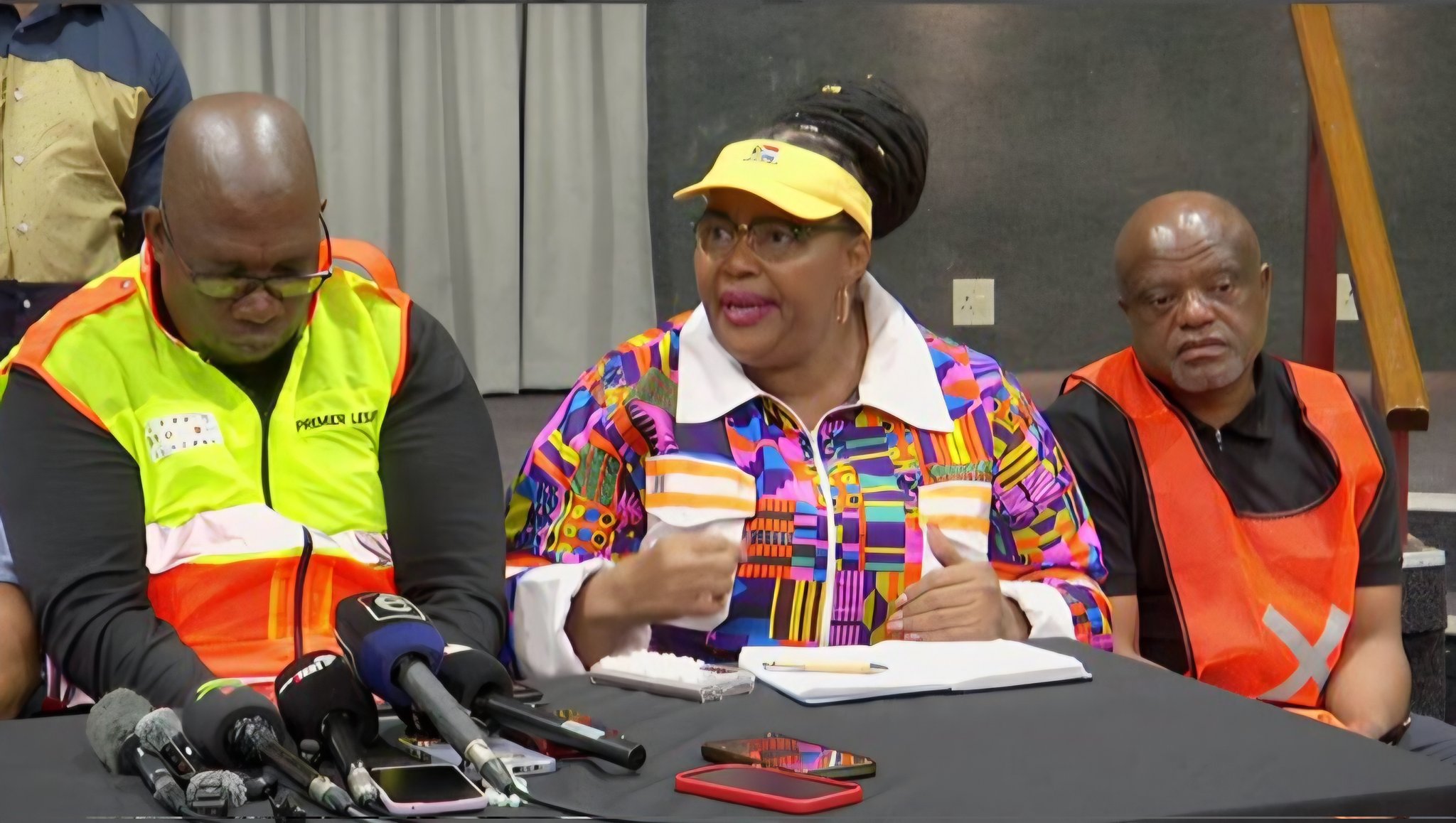
At a water-themed breakfast event on the sidelines of the summit, Majodina was seen singing what has since been dubbed a “water song” a moment that quickly went viral back home.
You can’t make this up! Are we going to import water from Ethiopia? Or what? The Pres told you to consult with water-starved communities in SA, not to jet off elsewhere. https://t.co/fzHeWPWY0S
Helen Zille (@helenzille) February 15, 2026
Optics versus obligations
In a country as politically charged as South Africa, optics matter.
The sight of a minister singing at an international summit while residents queue at water tankers did not land well with many. Social media erupted, with critics accusing government of being out of touch.
Among the loudest voices was Democratic Alliance federal chair and Joburg mayoral candidate Helen Zille, who questioned the timing of the trip and whether it aligned with the president’s earlier directive.
For frustrated residents in areas that have gone days in some cases weeks without water, the anger is less about diplomacy and more about daily survival.
A city on the brink
Johannesburg likes to call itself a “World-class African City.” Lately, that slogan rings hollow.
Dry taps. Leaking infrastructure. Ageing pipes. Labour disputes. Maintenance backlogs. All have fed into what is now being described as a deepening water crisis.
Some communities have endured outages for nearly a month. Tanker deliveries have become part of daily life in certain neighbourhoods. The phrase “day zero” once associated mainly with Cape Town’s 2018 drought scare is now creeping into conversations in Gauteng.
The reality is complex. Demand for water remains high, infrastructure is ageing, and municipalities often lack both technical skills and financial muscle to maintain systems properly.
The R400 billion problem
On the sidelines of the AU summit, Majodina acknowledged the scale of the challenge back home.
She previously indicated that roughly R400 billion would be needed to repair and upgrade water infrastructure at local government level funding that is currently not available.
She stopped short of committing to additional budget allocations for Gauteng, saying she and Deputy Minister David Mahlobo could not promise extra funds for the province at this stage.
The minister has also pointed to municipalities’ inability to maintain infrastructure and a shortage of skills as key drivers of persistent water shortages.
In other words, this crisis is years in the making.
The bigger picture
There is a certain irony in discussing sustainable water systems on a continental stage while South Africa’s economic hub struggles with basic supply.
Yet the AU theme is not misplaced. Water insecurity is a growing challenge across Africa, exacerbated by climate change, population growth and infrastructure strain. South Africa is not immune.
The uncomfortable truth is that Johannesburg’s water woes are not the result of one bad week or one absent minister. They reflect decades of underinvestment, governance failures and capacity gaps at municipal level.
Still, leadership during a crisis is judged as much by symbolism as by spreadsheets.
For residents filling buckets and rearranging their lives around unpredictable supply, what they want most is not a song but a solution.
And until the taps run steadily again, that pressure will not ease.
{Source: The Citizen}
Follow Joburg ETC on Facebook, Twitter , TikTok and Instagram
For more News in Johannesburg, visit joburgetc.com