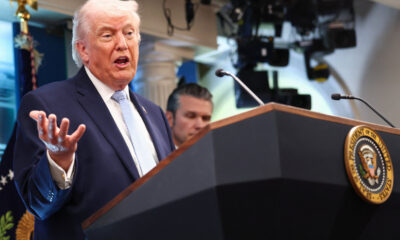
Pretoria keeps its cards close as new 10% US import levy takes shape
Just when global markets thought the trade war drama had cooled, another twist landed.
In a major ruling, the US Supreme Court struck down sweeping tariffs introduced by Donald Trump under his so-called “Liberation Day” strategy. But instead of clarity, the decision has ushered in fresh uncertainty and South Africa is watching quietly from the sidelines.
A court ruling with global ripples
In a narrow 6–3 decision, the court ruled that Trump had overstepped his authority by using the International Emergency Economic Powers Act (IEEPA) to impose broad tariffs without congressional approval.
The justices made it clear: IEEPA does not authorise a president to create sweeping tariffs. If Congress had intended that, they said, it would have spelled it out in law.
The invalidated tariffs reportedly raised between $133 billion and $175 billion in less than a year. Now, legal questions loom over whether refunds may follow and who ultimately pays the price.
Legal scholars like Harold Krent from Chicago-Kent College of Law have described the judgment as a defining moment for constitutional limits on presidential power.
Markets breathe, then brace
Financial markets initially reacted positively, interpreting the ruling as a signal that aggressive trade barriers might be curbed. Nigel Green of deVere Group said the decision challenges the economic doctrine that tariffs could single-handedly revive domestic industry.
In reality, many of those costs filtered down to consumers.
But relief was short-lived.
Within hours of the ruling, Trump shifted gears. Using Section 122 of the Trade Act of 1974, he announced a temporary 10% ad valorem import duty on most goods entering the US for 150 days, effective 24 February. Existing national security tariffs under Section 232 and Section 301 measures remain intact.
In other words, the trade pressure hasn’t disappeared, it’s just been recalibrated.
Pretoria says little, for now
Back home, the South African government has chosen not to weigh in publicly. Officials from the Department of Trade, Industry and Competition declined to comment as negotiations with Washington continue behind closed doors.
That silence comes at a delicate time.
Last year, South Africa faced the threat of tariffs exceeding 30% on certain exports to the US. The fresh 10% levy adds another layer of complexity for local exporters already navigating currency volatility and load shedding at home.
On South African business forums and X (formerly Twitter), reaction has ranged from cautious optimism to frustration. Some see the court ruling as a positive sign that US trade policy may face institutional checks. Others warn that the temporary levy shows protectionism is still firmly in play.
Where Agoa fits in
Trade experts say the African Growth and Opportunity Act (Agoa) could once again become central to South Africa’s export strategy.
Agoa allows eligible sub-Saharan African countries preferential access to US markets, reducing underlying duties that average around 3.5%. According to Donald McKay of XA International Trade Advisors, if the new 10% tariff sits on top of lower underlying Agoa rates, South African exporters may regain some competitive footing.
But he cautions that Trump still has other tools at his disposal, including Section 232 national security tariffs and Section 301 investigations. These measures require more formal processes, making them harder to deploy and maintain, but they remain available.
A shifting trade landscape
For South Africa, the implications are mixed.
The Supreme Court ruling removes one aggressive instrument from the White House’s arsenal. Yet the rapid introduction of a new global levy signals that Washington’s broader protectionist direction hasn’t changed.
The bigger question is strategic: should Pretoria double down on diplomatic engagement with the US, or accelerate diversification toward alternative markets?
For now, government officials are keeping their public statements brief. Behind the scenes, however, the calculations are undoubtedly complex.
In global trade, silence doesn’t mean inactivity. It often means negotiations are underway.
And as the clock ticks toward the implementation of the 10% import levy, South Africa’s exporters, from agriculture to automotive, will be watching developments in Washington just as closely as policymakers in Pretoria.