News
South Africa steps in as rescue teams head to flood hit Mozambique
When the floodwaters rose across Mozambique’s southern and central provinces, the call for help travelled quickly across borders. Within days, South Africa responded. A specialist rescue team was wheels up, heading east, carrying not only ropes and aircraft expertise but also a clear message of regional solidarity.
At the heart of the response is Rescue South Africa, which confirmed it had deployed a swift water and aviation rescue team to Mozambique following a formal request from the United Nations Office for the Coordination of Humanitarian Affairs. The decision came after consultation with South Africa’s disaster authorities, who confirmed there were no immediate domestic emergencies requiring the organisation’s full attention.
Why this mission matters now
Mozambique is facing one of its most severe flooding events in recent memory. Heavy rains that began in mid December intensified into January, pushing rivers beyond capacity and submerging entire neighbourhoods. In provinces such as Maputo, Gaza, and Zambezia, families have been left stranded on rooftops, waiting for helicopters to reach them.
Local officials and international agencies estimate that over half a million people have been affected. Roads have been washed away. Clinics and hospitals have suffered damage. In many areas, air rescue has become the only viable lifeline.
This is where the South African team’s expertise becomes crucial. Much of the operation relies on helicopter hoisting across vast, inaccessible areas where boats and vehicles simply cannot reach.
A uniquely South African collaboration
The deployment is being conducted under the South African flag and aligned with national and international humanitarian coordination frameworks. It is also backed by academic support from the University of Johannesburg and Nelson Mandela University, which are contributing technical and medical expertise to strengthen operational readiness on the ground.
The rescue team is led by Connor Hartnady and includes Travis Trower, Dr Dagmar Muhlbauer Roets, Bradley Hatfield, Francois Pretorius, and Xavier Millar. Together, they bring years of experience in complex rescue environments where speed, coordination, and calm decision-making can mean the difference between life and death.
View this post on Instagram
Boots and rotors already on the ground
By midweek, the team had landed in Maputo and begun coordinating with local and international partners. The scale of the disaster has demanded a highly structured approach, with helicopters covering wide areas and prioritising the most vulnerable communities first.
The International Federation of Red Cross and Red Crescent Societies has warned that widespread infrastructure damage has left many Mozambicans dependent on external humanitarian relief. That reality has sharpened the urgency of every sortie into flooded zones.
SANDF steps in from the skies
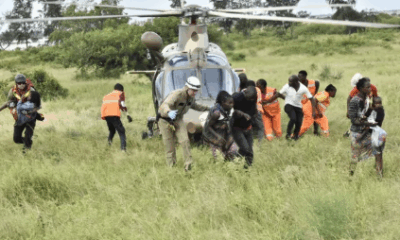
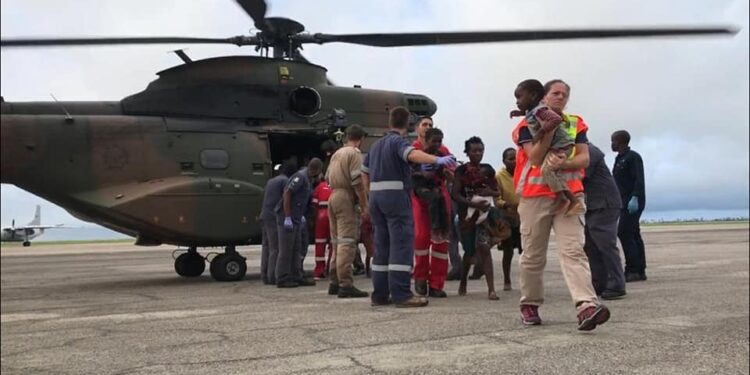
Alongside the civilian response, the South African National Defence Force has also deployed air assets as part of Operation CHARIOT. An Oryx helicopter from the South African Air Force was sent to support search and rescue efforts, operating in cooperation with Mozambican emergency services.
Despite challenging weather conditions, South African aircrews have already evacuated more than 200 people to safety following aerial reconnaissance missions in flooded areas of Maputo province. Additional aircraft are expected to reinforce the mission as conditions allow.
A familiar story in the region
For many in Southern Africa, the scenes unfolding in Mozambique feel painfully familiar. Climate-driven weather extremes are becoming more frequent, and regional cooperation is no longer optional. It is essential.
On social media, South Africans have largely responded with pride and support, praising rescue crews for stepping in beyond the country’s borders while acknowledging the shared vulnerabilities of the region. Mozambican users have echoed that gratitude, with images of helicopter rescues spreading widely online.
Beyond this emergency
Rescue South Africa has reiterated that its priority remains domestic response when needed. Yet this deployment reflects a broader commitment to regional stability and humanitarian cooperation. In moments like these, borders matter less than people.
As floodwaters slowly begin to recede in some areas, the work is far from over. Recovery will take months. For now, though, the sound of helicopter blades over submerged settlements signals something powerful. Help has arrived.
Follow Joburg ETC on Facebook, Twitter, TikT
For more News in Johannesburg, visit joburgetc.com
Source: IOL
Featured Image: The Southern African Times