News
US Moves Closer To Cutting South Africa Out Of Key Trade Deal
US Moves Closer To Cutting South Africa Out Of Key Trade Deal
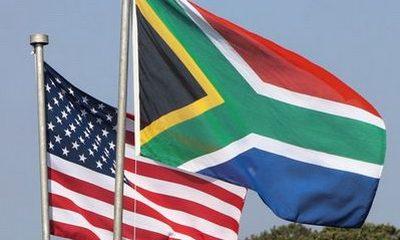
South Africa’s already strained relationship with the United States has entered a far more serious phase, with Washington openly considering removing the country from one of its most important trade agreements with Africa.
At the centre of the storm is AGOA, the African Growth and Opportunity Act, a long-standing programme that gives eligible African countries duty-free access to the US market. While the agreement expired in September, it has traditionally been renewed with broad bipartisan support. This time, South Africa’s place in it is no longer guaranteed.
What was once quiet diplomatic pressure is now being said out loud, in public hearings and proposed legislation, signalling that Pretoria is facing a real economic and political reckoning.
Why South Africa Is Being Singled Out
Speaking at a US Senate Appropriations subcommittee hearing this week, United States Trade Representative Jamieson Greer made it clear that South Africa is viewed differently from other African countries.
He told lawmakers he would be open to treating South Africa separately if AGOA is extended, describing the country as a “unique problem” in Washington’s eyes. Greer said South Africa has erected trade barriers against US goods and argued that its size and industrial capacity mean it should be importing more from America.
He added that South Africa would need to lower tariffs and non-tariff barriers on US products if it wanted Washington to reconsider the 30% duties currently imposed on South African exports.
Those duties were introduced in August after, according to US officials, trade proposals from Pretoria went unanswered.
AGOA Extension Comes With Strings Attached
While the Trump administration supports a one-year extension of AGOA, Greer confirmed that the short renewal would be used to rework the programme alongside Congress.
That opens the door for political conditions to be attached, especially for countries seen as out of step with US interests.
South Africa’s trade ministry has responded by reaffirming its commitment to lobbying for inclusion, saying it wants AGOA renewed in its current form. Behind the scenes, officials know exclusion would have serious consequences for exporters in sectors like automotive manufacturing, agriculture, and value-added goods.
Politics, Not Just Trade
The trade tensions are closely tied to deteriorating diplomatic relations. The US recently boycotted a G20 leaders’ summit hosted by South Africa and has already confirmed Pretoria will be excluded from the G20 summit in Miami next year.
US Secretary of State Marco Rubio has accused South Africa’s government of racism against white citizens, a claim echoed by President Donald Trump. These allegations have further poisoned relations and shifted the discussion well beyond tariffs and trade rules.
Among South Africans, the accusations have sparked anger and disbelief, with many seeing them as politically motivated rather than grounded in local reality.
Republicans Push To Remove South Africa Entirely
Pressure on South Africa intensified in November when US Senator John Kennedy introduced new legislation that would explicitly remove South Africa from AGOA.
The proposed AGOA Extension and Bilateral Engagement Act, dubbed “AGOA 2.0”, would extend the programme for two years but only for countries deemed supportive of US interests. South Africa’s participation would be formally reviewed, with the bill directly excluding it from the new framework.
Kennedy has framed the move as necessary to counter China’s growing influence in Africa, arguing that AGOA should reward geopolitical alignment, not just economic participation.
What The Bill Would Mean In Practice
If passed, the legislation would require a full review of US-South Africa relations and a certification from President Trump on whether South Africa undermines US national security.
It also calls for a classified list of South African government officials and African National Congress members who could face sanctions under the Global Magnitsky Act.
Most significantly, the bill explicitly ends South Africa’s eligibility for AGOA benefits, a move that would mark a dramatic break from more than two decades of preferential trade relations.
Why This Matters At Home
For South Africans, AGOA has long been an underappreciated pillar of export growth, supporting thousands of jobs and attracting foreign investment. Business leaders have already warned that exclusion would raise costs, reduce competitiveness, and hit manufacturing hubs particularly hard.
On social media, reactions have ranged from concern among economists to frustration from ordinary South Africans who feel caught in a geopolitical fight they did not choose.
As one user posted on X, “Trade deals should be about trade, not punishing countries for foreign policy choices.”
A Relationship At A Crossroads
What is clear is that South Africa’s relationship with the United States is at a crossroads. What happens next will depend on whether Pretoria can reset trade talks, and whether Washington decides that punishment is more effective than engagement.
Either way, the era of South Africa being an automatic inclusion in AGOA appears to be over, and the economic consequences could be felt long after the political noise fades.
{Source:Business Tech}
Follow Joburg ETC on Facebook, Twitter , TikTok and Instagram
For more News in Johannesburg, visit joburgetc.com