News
US democracy in decline as Human Rights Watch raises authoritarianism alarm
For decades, the United States has positioned itself as a global champion of democracy. This week, that image took a heavy knock.
Human Rights Watch has warned that the US is now drifting towards authoritarian rule, placing it in troubling company at a time when global democracy has sunk to its weakest point in forty years. The assessment comes in the organisation’s latest annual report, released as President Donald Trump settles back into the White House.
The tone is unusually stark. According to the New York-based rights group, the US is no longer just struggling with democratic strain. It is actively shifting away from long-held norms.
A sharper turn under Trump’s return
Human Rights Watch says the decline did not begin overnight. Democratic backsliding was already underway, fuelled by global pressures from authoritarian heavyweights like Russia and China. Trump’s return, however, has intensified what the group describes as a downward spiral.
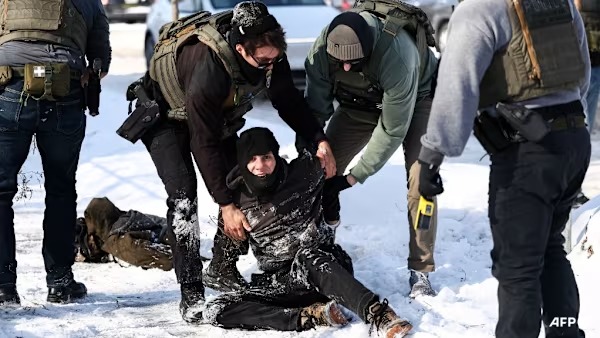
The report accuses the administration of open disregard for human rights, pointing to aggressive immigration enforcement and the use of masked, armed Immigration and Customs Enforcement agents in hundreds of raids that it describes as violent and abusive.
Even more alarming is the broader pattern Human Rights Watch highlights. It cites racial and ethnic scapegoating, the domestic deployment of National Guard forces under questionable justifications, retaliation against political critics and former officials, and repeated efforts to weaken democratic checks on executive power.
Taken together, the organisation says these actions mark a decisive shift towards authoritarian governance in the US.
Allegations that shocked even seasoned observers
Some of the findings would have been unthinkable in previous US-focused human rights reports.
Human Rights Watch repeated its claim that the United States engaged in enforced disappearances by transferring 252 Venezuelan migrants to a maximum security prison in El Salvador. Under international law, enforced disappearance is considered a serious crime.
In a separate investigation, the group documented allegations from the men after they were later allowed into Venezuela. These included reports of torture, beatings, and sexual violence.
The US State Department has taken a very different tone in its own reporting, downplaying concerns about El Salvador and praising President Nayib Bukele’s crackdown on gangs for driving crime to historic lows. Human Rights Watch counters that while gang violence has declined, authorities have carried out widespread abuses, including mass arbitrary detention and torture.
‘Less free’ than before
One of the most striking claims in the report is comparative. Human Rights Watch says global democracy metrics have fallen back to levels last seen in 1985, when the Soviet Union still existed.
Russia and China, it notes, are less free than they were twenty years ago. So too, it argues, is the United States.
Philippe Bolopion, the organisation’s executive director, has urged countries to form alliances rooted in democracy, international law, and human rights rather than convenience. In a world of shifting loyalties and trade pressure, he warned that value-based alliances offer the only durable protection.
Global context and widening fault lines
The report also revisits Human Rights Watch’s highly controversial findings on Israel’s conduct in Gaza, repeating its conclusion that Israeli authorities committed crimes against humanity, acts of genocide, and ethnic cleansing during 2025. Israel has fiercely rejected the accusation, with Washington backing its ally.
For South African readers, the report lands at a moment when questions about power, accountability, and democratic resilience feel particularly close to home. The warning from Human Rights Watch is not just about Washington. It is about how quickly institutions can erode when leaders test the limits and how fragile democracy can be when norms are treated as optional.
Whether the US heeds that warning remains to be seen. What is clear is that the language used to describe America’s democratic health has changed, and not for the better.
Follow Joburg ETC on Facebook, Twitter, TikT
For more News in Johannesburg, visit joburgetc.com
Source: IOL
Featured Image: CNA