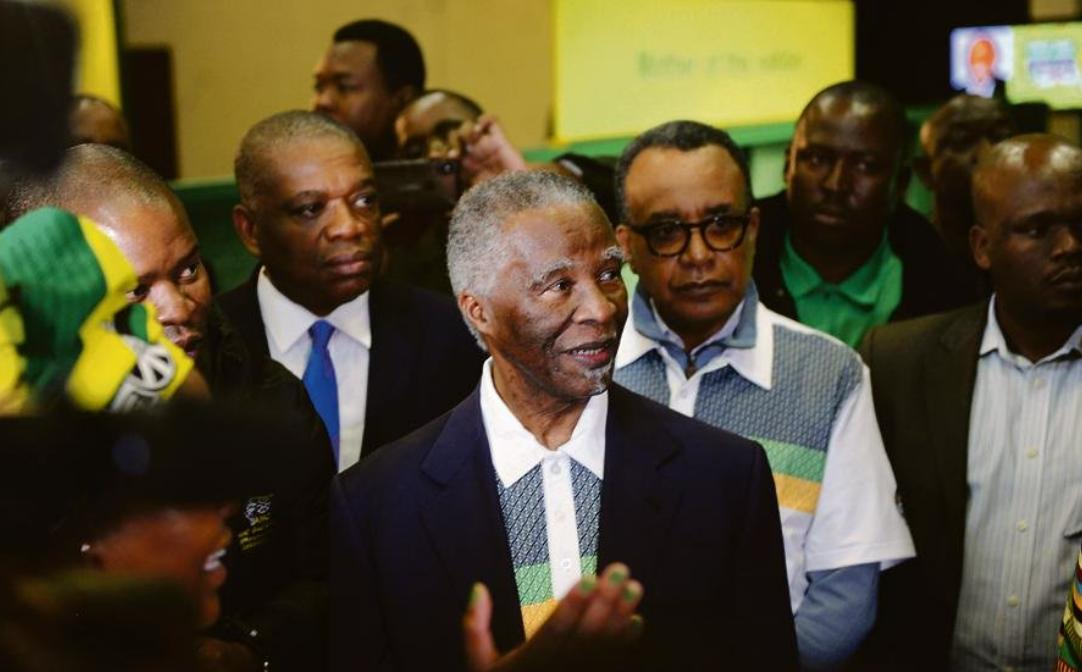
South Africa’s unemployment crisis has once again taken centre stage, this time sparked by remarks from former president Thabo Mbeki that have struck a nerve across the country.
Speaking in a recent interview, Mbeki suggested that millions of South Africans remain jobless because they simply do not have the skills needed for today’s economy. It is a blunt assessment that has reopened an old and deeply uncomfortable question. Is unemployment in South Africa really about skills, or is the problem far bigger?
A Harsh Diagnosis Of The Workforce
Mbeki did not hold back. He argued that the country’s high unemployment rate is driven by a workforce that is not equipped for modern economic demands. In his view, this gap explains why so many people remain locked out of job opportunities.
He also took aim at South Africa’s welfare system, warning that celebrating the growing number of people relying on social grants should not be seen as progress, but rather as a sign of failure.
It is a perspective that echoes a long-standing argument in policy circles. South Africa has a skills mismatch problem, where what people learn does not always align with what employers actually need.
Critics Say The Roots Go Deeper
Political analyst Siya Ntombela agrees that there is a disconnect between education and employment. But he believes the issue cannot be separated from history, including decisions made during Mbeki’s own time in office.
Ntombela points to major education reforms introduced in the late 1990s and early 2000s, particularly the shift toward a unified Further Education and Training system. These changes, guided by policies like the 1998 education framework, aimed to streamline vocational training after apartheid.
However, the restructuring also led to the closure of several vocational, teaching and nursing colleges. According to critics, that move had long-term consequences, reducing the country’s ability to produce skilled workers in key sectors.
In many ways, the current crisis reflects decisions made decades ago, where the intention to modernise education may have unintentionally weakened practical skills pipelines.
A System Under Pressure
Beyond policy history, there are ongoing challenges that continue to widen the gap between education and employment.
Load shedding remains a major obstacle, particularly for technical and vocational training that depends on consistent electricity. Students who need hands-on experience often find themselves unable to complete practical work, leaving them underprepared for the workplace.
Ntombela also criticised the broader education culture, suggesting it has prioritised passing exams over developing real-world skills. The result, he argues, is a growing number of graduates who hold certificates but struggle to meet job market demands.
Jobs Or Skills? The Bigger Question
Trade union leader Zwelinzima Vavi has strongly rejected the idea that unemployment can be explained by skills alone.
He paints a stark picture. Millions of South Africans remain unemployed, many of them for extended periods. Young black South Africans, especially those in rural areas, are among the hardest hit.
For Vavi, the issue is not just about whether people are qualified. It is about whether the economy is creating enough jobs in the first place. Even with improved education and training, he argues, the current economy is simply not absorbing workers at the scale needed.
This shifts the conversation from classrooms to boardrooms and policy tables. It raises a critical question. Can skills alone solve unemployment if the economy itself is not growing fast enough?
A Divided View On The Way Forward
Not everyone disagrees with Mbeki. Commentator Ernst Roets has backed the former president’s view, arguing that skills remain a central part of the problem.
The divide highlights a deeper national debate. One side sees unemployment as a failure of education and skills development. The other sees it as a structural issue tied to economic growth, inequality and limited opportunities.
The Reality Facing South Africans
South Africa’s unemployment crisis is not new, but moments like this bring its complexity into sharp focus.
It is a story of policy decisions made over decades, an education system still finding its footing, and an economy that struggles to keep pace with a growing population.
Mbeki’s comments may have sparked controversy, but they have also forced a necessary conversation. Solving unemployment will likely require more than one answer. It will demand both a stronger education system and an economy capable of creating real, sustainable jobs.
For millions of South Africans still searching for work, that solution cannot come soon enough.