The electric revolution is coming to BMW’s most important nameplate. The German marque has confirmed that the i3 sedanthe electric iteration of the iconic 3 Serieswill arrive in South Africa in the first quarter of 2027. And if the numbers are anything to go by, it’s worth the wait.
Unveiled initially in 50 xDrive guise, the BMW i3 employs a dual electric-motor powertrain producing a combined system output of 345 kW and 645 N.m of torque. That’s serious power by any measure, though BMW has yet to announce performance figures such as 0-100 km/h sprint time and top speed. Given the numbers, expect it to be rapid.
The Technology Underpinning It
The i3 represents the first South African outing for BMW’s sixth-generation eDrive technology. The system incorporates 800V architecturea significant leap forward that enables capabilities far beyond simply moving the car.
The 800V setup allows for bi-directional charging across three formats:
-
Vehicle-to-load (V2L): The i3’s battery can power external devices such as small appliances, tools, or camping equipment.
-
Vehicle-to-home (V2H): It can act as a power source for a houseparticularly useful in a country familiar with load-shedding.
-
Vehicle-to-grid (V2G): It can feed energy back into the power grid, potentially allowing owners to sell electricity back during peak times.
For South Africans who have endured years of unreliable power supply, the V2H capability alone could be a game-changer. An electric car that can power your home during outages is not just a vehicle; it’s a backup generator on wheels.
The Range and Charging Claim
Although BMW hasn’t confirmed the exact battery capacity, the company says the “high-voltage” item is capable of receiving up to 400 kW at a DC fast-charging station. Plugged into such a facility, a 10-minute top-up provides 400 km of range, the firm claims.
That is extraordinary. Ten minutes for 400 kilometres means charging stops become barely longer than a quick coffee break. It addresses one of the primary anxieties of electric vehicle ownership: the time spent plugged in.
The Bavarian brand claims a combined operating range of 900 kilometres on a single full charge, according to WLTP testing. If accurate, that puts range anxiety firmly in the rear-view mirror. A 900km range means most South Africans could drive from Johannesburg to Cape Town with a single stopand that stop would be brief.
The Physical Proportions
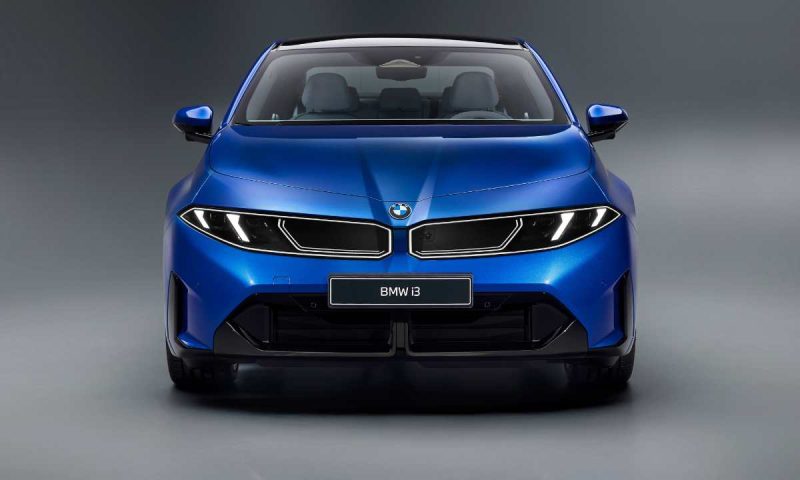
Pictured here in M Le Castellet Blue metallic paintwork, the i3’s sculpted sheet metal measures 4,760 mm in length and 1,865 mm in width. That makes it 64 mm longer and 38 mm wider than the current-generation internal combustion 3 Series.
The i3’s wheelbase is longer, too2,897 mm compared to 2,851 mm for the standard 3 Series. The electric sedan also stands 40 mm taller, at 1,480 mm. These dimensions suggest more interior space, particularly in the rear, where the longer wheelbase and absence of a transmission tunnel should liberate significant legroom.
The Design Language
The i3’s front facia is characterised by the most modern interpretation of BMW’s signature kidney grille. According to the company, the grille and twin headlamp array merge to form an innovative lighting signature. It’s a bold look that signals this is not merely an electrified 3 Series, but a distinct model with its own visual identity.
Sharply styled, tapered taillamps can be found round back, completing a design that is unmistakably BMW while pushing the brand’s aesthetics forward.
The Interior Experience
Stepping inside, the i3’s interior will be familiar to anyone who has seen its Neue Klasse SUV sibling, the iX3. The cabin plays host to BMW’s Panoramic Vision display, which spans the base of the windscreen and relays essential driving information to the driver. This augmented reality-style display is complemented by a 3D head-up display, ensuring that critical data is always within the driver’s line of sight without requiring eyes to leave the road.
Taking pride of place at the centre of the facia is an angular 17.9-inch touchscreen infotainment system. It’s a commanding presence that handles navigation, entertainment, and vehicle settings.
The M Performance Version
For those who find 345 kW insufficient, BMW has news: a full-fat M model is in the works and will be introduced next year. The halo all-electric 3 Series will be equipped with four electric motors, each driving an individual wheel.
Although details surrounding this powertrain’s power output remain thin, reports have suggested it will produce around 1,000 kW. That is supercar territoryacceleration that would have seemed impossible for a four-door sedan just a few years ago. The quad-motor setup also allows for torque vectoring at each wheel, potentially offering handling characteristics that no mechanical all-wheel-drive system can match.
The South African Context
The i3’s arrival in Q1 2027 places it at the leading edge of South Africa’s electric vehicle transition. Charging infrastructure remains a work in progress, but the i3’s 900km range and rapid charging capability reduce dependence on public chargers for most daily use.
The V2H capability is particularly relevant. South Africans have learned to value energy resilience, and a car that can power a home during load-shedding adds practical value beyond transportation.
Pricing has not yet been announced. Electric vehicles command premiums over their internal combustion equivalents, and the i3’s advanced technology will not be cheap. But for early adopters and those who want the most advanced 3 Series ever built, the i3 will be worth watching.
The Significance
The i3 matters because the 3 Series matters. It is BMW’s core, the car that defines the brand for millions of customers. Electrifying it signals that BMW believes the electric future has arrivednot just for niche models or city cars, but for the sedan that has been the heart of its lineup for decades.
With 345 kW, 900 km range, and 10-minute charging, the i3 is not a compromise. It is not an electric car that asks drivers to accept less. It is, on paper at least, a better 3 Seriesmore powerful, more efficient, more technologically advanced.
South Africans will get their first chance to judge for themselves in early 2027. The countdown begins now.