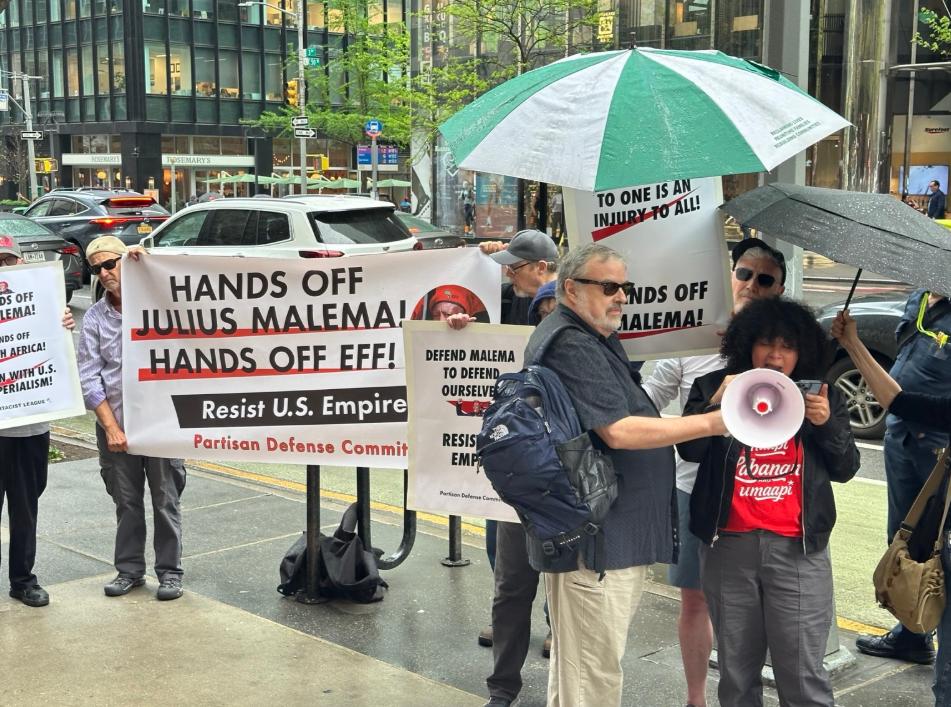
Small Crowd, Big Message In Manhattan
On a quiet Sunday in Manhattan, a small but vocal group of activists gathered outside the South African Consulate-General with a clear message: “Hands off Malema.”
The demonstration, organised by groups including the Partisan Defense Committee, the Spartacist League and the Internationalist Group, may not have drawn large numbers, but it signalled something bigger. South Africa’s domestic political battles are increasingly spilling onto the global stage.
The protest followed the sentencing of Julius Malema, leader of the Economic Freedom Fighters, who was handed an effective five-year prison term by the East London Magistrate’s Court over firearm-related charges tied to a 2018 rally in Mdantsane.
Legal Battle Far From Over
Despite the sentencing, Malema has not been jailed. His legal team successfully secured leave to appeal, meaning the case will continue through the courts before any prison time is enforced.
The charges stem from a moment that has lingered in South Africa’s political memory. At the 2018 rally, Malema was seen handling what prosecutors argued was a firearm, leading to a case that has now culminated in one of the most high-profile political sentences in recent years.
For many in South Africa, the case raises deeper questions about accountability, political theatre and the fine line between symbolism and legality in a charged political environment.
US Politics Enters The Conversation
What made the New York protest particularly striking was not just its location, but its messaging.
Some demonstrators claimed that Donald Trump had influenced the outcome of Malema’s case, calling the conviction politically motivated. There is no evidence supporting this claim, but it reflects how global narratives are increasingly shaping perceptions of South African politics.
Trump has repeatedly made controversial statements about South Africa, including claims about violence against white farmers. These assertions have been widely disputed by local authorities and independent experts, yet they continue to resonate in certain international circles.
His administration also previously introduced a refugee pathway specifically for white South Africans, adding another layer to the already complex relationship between the two countries.
A Controversial Figure With Global Reach
Malema has long been one of South Africa’s most polarising political figures. From fiery speeches to his use of struggle-era songs like “Kill the Boer,” he has attracted both fierce support and sharp criticism, locally and abroad.
Figures such as Elon Musk have weighed in on the debate, criticising aspects of South African political rhetoric and fuelling international scrutiny.
But for supporters, Malema represents a voice challenging inequality and pushing for radical economic change in a country still grappling with the legacy of apartheid.
From Local Courtroom To Global Stage
Back home, support for Malema has been far more visible, with larger demonstrations taking place across South Africa. The New York protest, though modest in size, shows how his case has become part of a broader global conversation about politics, race and economic justice.
It also highlights a shift in how local political developments are consumed internationally. What happens in a courtroom in the Eastern Cape can now spark reactions thousands of kilometres away.
As the appeal process unfolds, one thing is clear. This is no longer just a legal case. It is a story about power, perception and how South Africa’s politics are being watched and debated far beyond its borders.