News
Kubayi defends R76.4m spent on foreign-language court interpreters

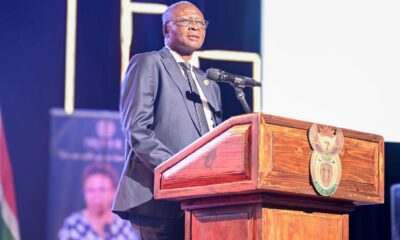
Justice and Constitutional Development Minister Mmamoloko Kubayi has defended a R76.4 million bill for foreign-language interpreting services used in criminal court proceedings over the past year, saying the expenditure is part of the department’s constitutional duty to ensure accused persons can follow and participate in trials.
Minister frames spending as constitutional obligation
Kubayi told parliament the department provides interpretation services “in fulfilment of its constitutional obligation, which guarantees every accused person the right to be tried in a language that they understand or to have proceedings interpreted.”
How the money was spent
The department said the R76.4m outlay was largely made up of travel costs and tariffs paid to foreign-language interpreters, and that some interpreters charge special rates for scarce languages and dialects. Kubayi said procurement procedures were followed and that the department “utilises an established central database from which interpreters are sourced.”
Provincial breakdown
- Gauteng: R20.9m
- KwaZulu-Natal: R15m
- North West: R7.2m
- Northern Cape: R7.2m
- Free State: R5.4m
- Eastern Cape: R4.6m
- Western Cape: R4.1m
- Limpopo: R3.5m
- Mpumalanga: R2.9m
Costs by language
Kubayi said Shona attracted the highest national expenditure at R8.7m. Other reported language costs included:
- Chichewa (Malawi): R7.7m
- Amharic (Ethiopia): R7m
- Shangaan (Mozambique): R6.8m
- Igbo (Nigeria): R6m
- Swahili/Kiswahili (DRC): R5.3m
- Portuguese (Mozambique/Angola): R3.6m
- Urdu (Pakistan): R3.6m
- Mandarin (China): R2.7m
- Bangla (Bangladesh): R2.6m
- Zim-Ndebele (Zimbabwe): R2.3m
- Arabic (Comoros/Morocco): R2.2m
- Oshiwambo/Herero/Ovambo (Namibia): R2.1m
Steps to reduce outsourcing and build capacity
The department has taken measures to reduce reliance on external interpreters, including appointing 42 permanent South African interpreters proficient in commonly required foreign languages such as Shona, Maputo Shangaan, Chichewa, Oshiwambo, Hindi, Portuguese and Swahili. Kubayi said the department is also using audio-visual interpretation services, optimising scheduling, and strategically deploying interpreters to where they are most needed.
She added the department is in the process of creating an additional 30 permanent interpreter posts to strengthen internal capacity and reduce outsourcing. Kubayi said the procurement policy under review seeks to remove special rates charged for scarce languages.
Case management, arrests and data systems
Kubayi told parliament that the National Prosecuting Authority or courts do not “track” whether persons released on bail later fail to appear. She said the database did not record whether foreign nationals were granted bail and subsequently failed to appear in court.
“If the accused is subsequently arrested, they will immediately be linked to outstanding warrants of arrest and be able to be brought to court on the initial charge.”
She said the South African Police Service is responsible for arrests and tracing accused persons who have absconded and that police have “tracing teams” who specialise in such functions.
Kubayi also noted that the Integrated Justice System (IJS) has identified several data and system integration challenges in processing and managing cases and persons. She said the IJS, in collaboration with the SAPS and the Department of Home Affairs, has implemented person identification and verification services that enable verification of an individual’s identity and status against DHA records at the point of arrest using one or multiple biometric traits.
Oversight and monitoring
On managing costs, Kubayi said the department monitors demand for interpretation services, interpreter availability, and expenditure trends across courts to ensure efficient utilisation of resources, and that external interpreters are engaged only where internal capacity is not available to ensure constitutional compliance.
These explanations were given in response to parliamentary questions from MP Thalente Kubheka.
Follow Joburg ETC on Facebook, Twitter, TikTok and Instagram
For more News in Johannesburg, visit joburgetc.com
Source: iol.co.za