Pressure mounts on South Africa over coal exports linked to Israel’s Gaza war
A growing political and ethical debate is unfolding in South Africa over coal exports allegedly linked to the war in Gaza, placing government policy, global trade and international law on a collision course.
At the centre of the storm is the claim by activists that South African coal is indirectly powering electricity systems used in Israel’s military operations in Gaza a claim that has intensified calls for urgent government intervention.
The debate is no longer just about trade. It is now about whether South Africa’s exports align with its stance at the International Court of Justice.
BDS demands immediate halt to coal exports
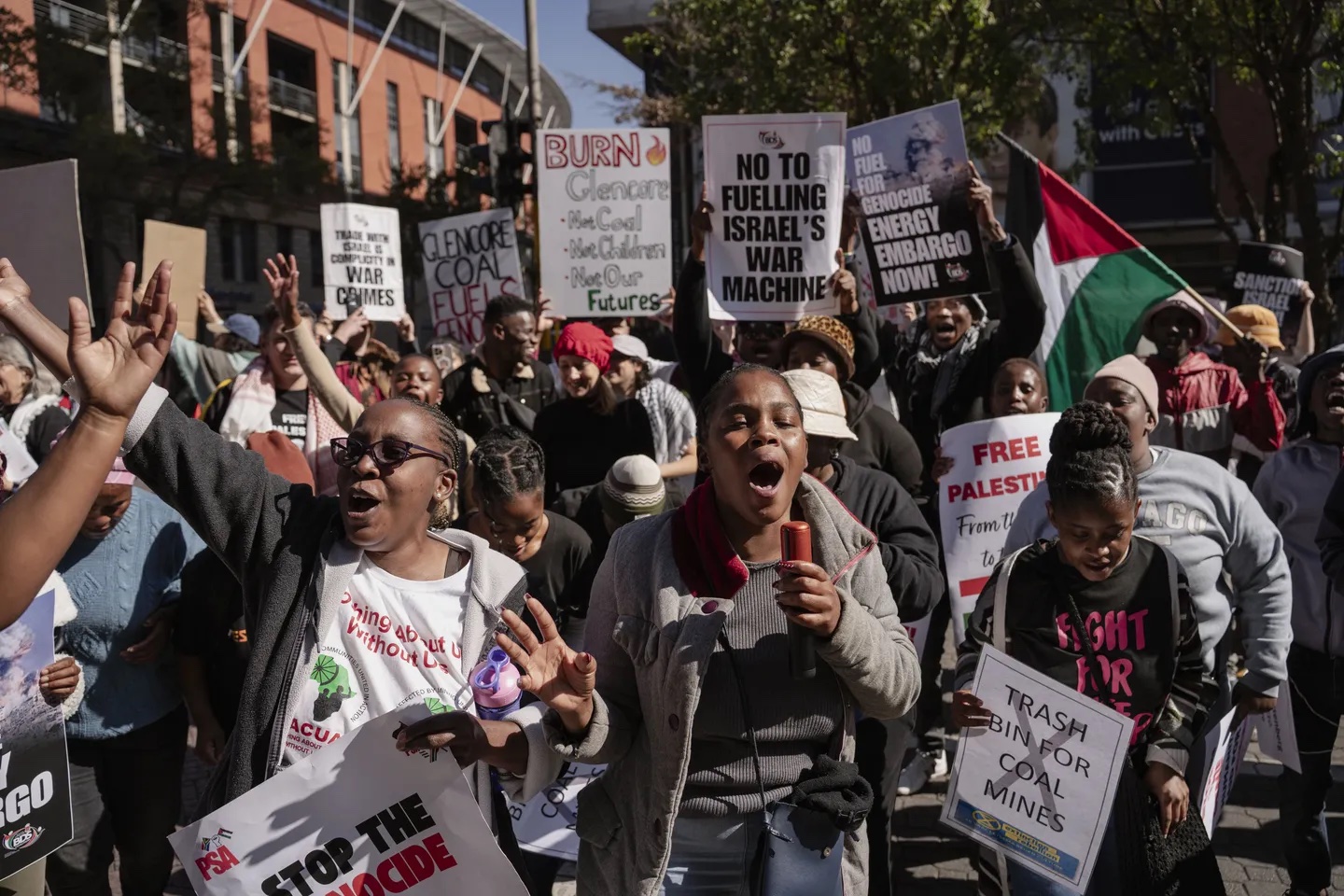
The South African Boycott, Divestment and Sanctions coalition has formally written to government, demanding an immediate stop to coal shipments to Israel.
The group argues that continuing exports contradicts South Africa’s legal and moral position after it approached the International Court of Justice over alleged genocide in Gaza.
According to the coalition, coal shipped from South Africa contributes to electricity generation in Israel, which is then used in military and technological systems connected to the conflict.
Their argument is rooted in international law, citing the ICJ’s finding that there is a plausible risk of genocide a ruling they say places a duty on states to avoid any form of complicity.
A clash between trade and foreign policy
The issue has exposed a difficult tension: South Africa’s economic ties versus its international human rights stance.
The BDS coalition has also escalated its campaign through formal letters to multiple government departments, including Trade, Industry and Competition, Transport, and International Relations.
They have called for:
- Immediate prohibition of coal exports to Israel
- Investigation and possible detention of vessels carrying coal
- Legal clarity on South Africa’s international obligations
Activists argue that allowing exports to continue weakens South Africa’s credibility at the ICJ.
Labour movement weighs in
The Congress of South African Trade Unions has also added its voice to the debate.
The federation says it supports international legal efforts to address the Gaza conflict and has backed calls for divestment, sanctions and boycotts against Israel.
Cosatu has also argued that stronger global action is needed, drawing comparisons to past sanctions imposed during apartheid-era South Africa.
The sentiment reflects a long-standing tradition in South African labour politics, where international solidarity movements have often played a visible role in foreign policy debates.
Government and industry response
Government departments have acknowledged receipt of the correspondence and say responses will follow.
However, mining industry representatives have taken a more cautious stance.
Industry bodies say they do not comment on individual export contracts between companies and international buyers.
Some mining companies linked to the trade have also declined public comment, while legal and commercial experts note that these agreements are typically governed by private contracts rather than direct state instruction.
Can South Africa actually stop the exports?
The question dividing analysts is whether government has the legal and practical power to halt exports that are controlled by private mining companies.
Some experts argue that while companies operate independently, the state still has regulatory tools that could influence or restrict certain trade flows under national policy or international obligations.
Others say direct intervention could face legal and diplomatic complications, especially where contracts already exist.
The debate highlights a deeper issue: how far a government can go in aligning commercial activity with foreign policy principles.
Public reaction: divided but emotionally charged
On social media, reactions have been sharply divided.
Some South Africans strongly support the BDS position, arguing that the country should not be linked in any way to a conflict involving civilian casualties.
Others say the issue is more complex, pointing out the role of private companies, global trade networks and contractual obligations.
What is clear is that the conversation is not abstract. It touches on South Africa’s identity as a country that has historically positioned itself on human rights issues in global conflicts.
A broader geopolitical dilemma
Political analysts say the dispute reflects a larger challenge facing emerging economies: balancing moral diplomacy with economic dependence on global trade systems.
South Africa’s membership in international groupings such as BRICS adds another layer, as trade relationships become increasingly politically sensitive.
At the same time, analysts note that coal remains a key export commodity, deeply embedded in private-sector supply chains.
What happens next
Government is expected to formally respond to the BDS coalition’s demands, while legal and policy debates continue behind the scenes.
For now, coal shipments continue, activism continues, and the political pressure continues to build.
But beyond the technical arguments, the core question remains simple and uncomfortable:
When trade, politics and conflict intersect, where does responsibility begin and where does it end?