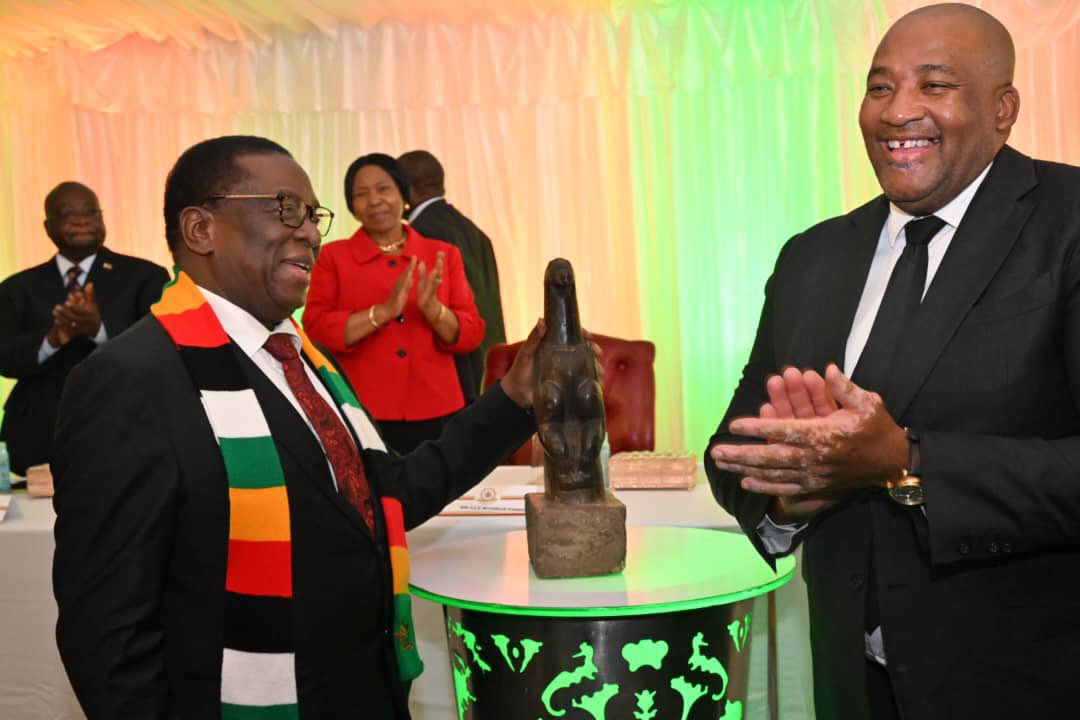
Zimbabwe Bird comes home after 137 years in landmark handover
A powerful symbol finally returns to its homeland
There are moments in African history that feel bigger than politics. This week was one of them.
After spending more than a century outside its homeland, the sacred Zimbabwe Bird has been returned to Zimbabwe by South Africa in a deeply symbolic handover led by Minister of Sport, Arts and Culture Gayton McKenzie.
The ceremony, held in Harare and received by President Emmerson Mnangagwa, also included the return of ancestral human remains taken during the colonial era.
For many Zimbabweans, this was not simply the arrival of an old sculpture. It was the return of memory, dignity and unfinished history.
Why the Zimbabwe Bird matters so much
The Zimbabwe Bird is one of the country’s most treasured national symbols. It appears on the national flag, official emblems and coins, and carries strong spiritual meaning linked to the ancient civilisation of Great Zimbabwe.
The stone bird taken in 1889 was removed during colonial occupation, becoming one of several artefacts scattered far from home.
McKenzie described the moment with a line that resonated widely: it was the first bird to leave, and the last to return.
That sentence alone captured generations of loss.
More than an artefact came back
Alongside the bird were the remains of eight Zimbabwean ancestors, returned after being kept in South Africa for decades as museum holdings and so-called scientific specimens.
At the ceremony, coffins draped in Zimbabwean flags stood beside dignitaries from both countries, turning what could have been a diplomatic event into something more solemn and human.
In many African traditions, burial and ancestral respect are sacred matters. Returning remains is often seen as restoring peace not only for families, but for communities and the land itself.
A painful colonial chapter revisited
Officials say some of the remains were removed from graves, while others were collected under coercive or violent colonial systems.
One set is believed to belong to a MaKalanga chief whose skull and jaw were taken in 1910 and held in a museum collection for over a century.
Stories like these are why repatriation debates across Africa continue to grow louder. Museums once framed such collections as preservation. Today, many see them as evidence of exploitation.
How the return finally happened
The Zimbabwe Bird had reportedly passed through colonial hands, including that of Cecil John Rhodes, and remained tied up in legal and administrative barriers for years.
Those obstacles were recently cleared after intervention at state level, allowing South African and Zimbabwean institutions to finalise the handover.
Even the original stone plinth from which the bird was removed was returned, meaning the symbol can now be restored more completely than at any time in the last century.
Public reaction across the region
Reaction online has been emotional and proud.
Many Zimbabweans described the return as overdue justice, while South Africans praised the move as a sign that neighbouring countries can work together to repair historical wrongs.
Others used the moment to ask a bigger question: how many more African treasures still sit in foreign museums, private estates or storage rooms?
That question has no simple answer, but it is being asked more often.
A new era for African heritage?
This handover arrives during a broader international push for former colonial powers and institutions to return looted African artefacts.
From Benin bronzes to sacred remains and royal objects, the continent is increasingly demanding ownership of its own story.
McKenzie made clear that this was not charity, but correction.
And that may be the most important point of all.
Why this moment will be remembered
The Zimbabwe Bird’s journey home is about far more than stone.
It is about identity reclaimed, ancestors honoured and history no longer told only through colonial archives.
For Zimbabwe, it is a proud national moment.
For South Africa, it is a chance to help right old wrongs.
For the continent, it is another sign that Africa’s past and future belongs in African hands.