Sourced: X {https://x.com/cgtnafrica/status/2032390345216954776?s=20}
Illegal mining crisis exposes South Africa’s policing problem
South Africa’s battle against illegal mining is no longer just about zama zamas operating underground. Increasingly, the spotlight is turning toward the people meant to stop them.
The recent arrests of senior police officials Major-General Feroz Khan and Gauteng Hawks head Major-General Ebrahim Kadwa have intensified concerns that organised criminal networks may be operating with protection from inside the state itself.
For many communities living near abandoned mines, these revelations are not shocking they are confirmation of what residents, activists and whistle-blowers have been warning about for years.
Arrests shake confidence in law enforcement
Khan and Kadwa were arrested in connection with alleged illicit precious metals dealings, corruption and defeating the ends of justice. Their arrests have sent shockwaves through both law enforcement and mining circles, especially because of their senior positions within the South African Police Service.
The allegations have also reopened difficult questions about how illegal mining syndicates continue to operate so openly despite repeated crackdowns, military-style operations and public promises to restore order.
Community organisation Mining Affected Communities United in Action (MACUA) believes the arrests point to something much bigger than isolated corruption.
According to the organisation, the problem reflects what it describes as a deeper system where parts of law enforcement allegedly overlap with politically connected business interests in mining, logistics and private security.
Communities say policing protects profits, not people
In many mining towns across Gauteng, North West and parts of the Free State, frustration has been growing for years.
Residents often complain that once mining companies leave, communities are left behind with collapsing infrastructure, unemployment and dangerous abandoned shafts that become hotspots for illegal mining activity.
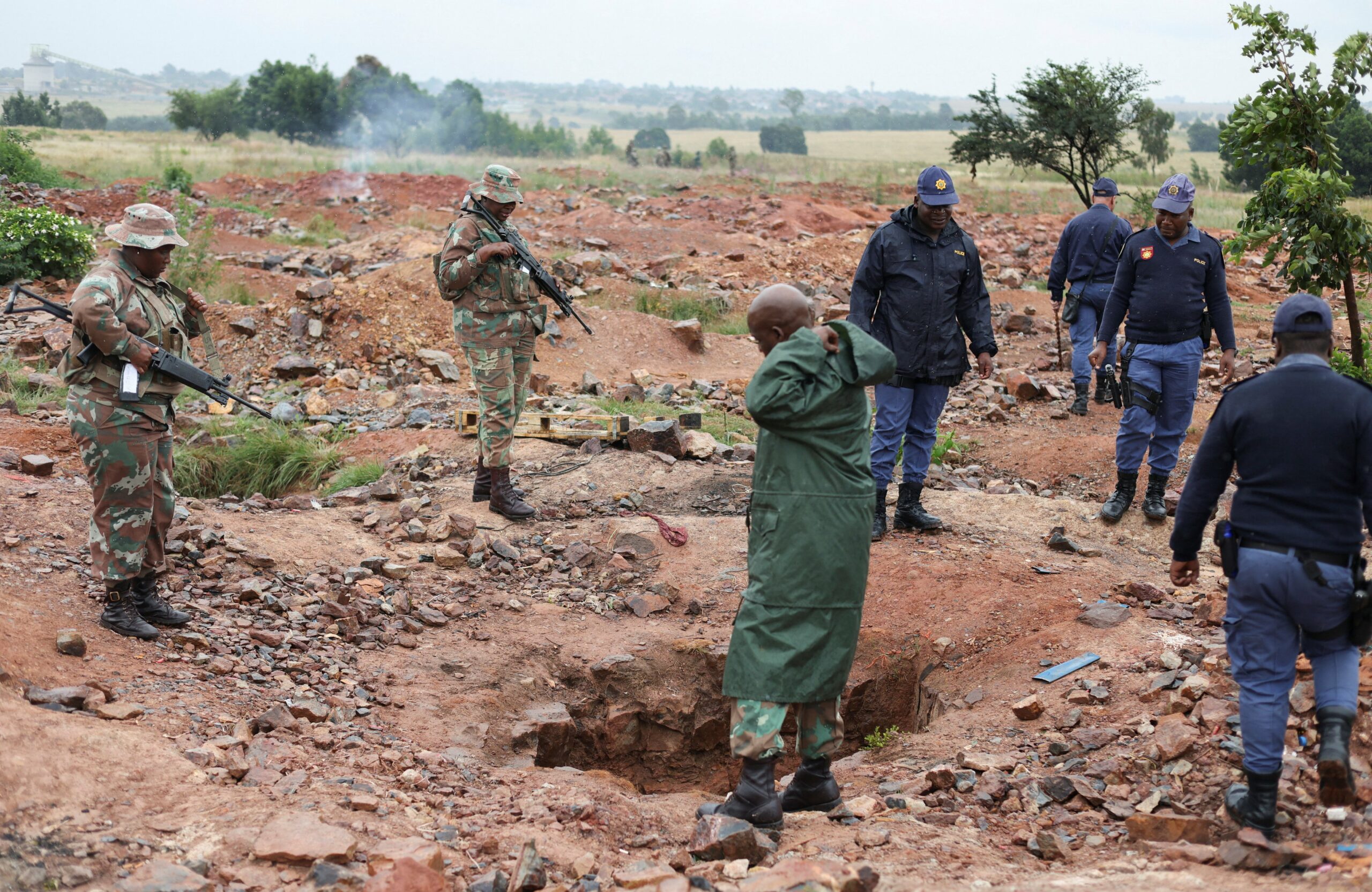
Operations such as Operation Vala Umgodi were introduced to clamp down on illegal mining networks. But critics argue that heavily armed raids and policing alone cannot solve a crisis rooted in poverty and economic exclusion.
MACUA spokesperson Sabelo Mnguni said many residents feel policing efforts focus more on protecting mining interests than helping communities survive.
That frustration is particularly strong in former mining regions where informal mining has become one of the few remaining economic activities available to desperate residents.
The “Tiger” escape still haunts investigators
The issue gained even more attention after the dramatic escape of alleged illegal mining kingpin James Neo Tshoaeli, commonly known as “Tiger”, from police custody in January 2025.
Tshoaeli was linked to illegal mining operations at Stilfontein’s abandoned gold mines, a region that has become symbolic of South Africa’s growing zama zamas crisis.
Security analyst Andy Mashaile believes escapes like these raise serious questions about internal collusion.
Many South Africans on social media have echoed similar concerns, with some arguing that illegal mining syndicates appear too sophisticated and well-connected to function without assistance from corrupt insiders.
Whistle-blower’s killing deepened fears
Public anxiety intensified further following the murder of whistle-blower Marius van der Merwe, also known as “Vlam”, in December 2025.
Van der Merwe had reportedly testified before the Madlanga Commission about alleged police involvement in illegal mining operations and the protection of criminal syndicates.
Hours before he was killed outside his Brakpan home, he allegedly shared voice notes claiming he possessed evidence implicating senior police and state officials in illegal mining activities.
His death sent fear through anti-crime activist circles and reinforced public suspicion that powerful interests may be benefiting from the illegal mining economy.
A national crisis hiding underground
Illegal mining has evolved into one of South Africa’s most dangerous underground economies.
Beyond gold theft and precious metals smuggling, authorities have linked syndicates to violent crime, human trafficking, extortion and arms trafficking. Entire communities living near abandoned shafts have become trapped between criminal groups, poverty and aggressive policing operations.
At the same time, critics say government responses continue to focus mainly on arrests instead of addressing the conditions that allow illegal mining to flourish in the first place.
South Africa’s abandoned mines remain largely unsecured, while economic opportunities in many former mining communities remain scarce.
SAPS vows crackdown amid mounting pressure
South African Police Service spokesperson Athlenda Mathe said allegations involving police collusion with illegal mining syndicates are being treated seriously.
Police insist investigations into leaked operational information, corruption and interference are continuing, adding that any officers found guilty will face criminal consequences.
But public trust remains fragile.
For many South Africans, the latest arrests are not just about two senior officials. They symbolise a growing fear that organised crime has penetrated some of the country’s most important institutions.
And until communities see meaningful accountability, many believe the real battle over illegal mining is not happening underground but inside the system itself.