News
Tehran Under Fire: Israel Strikes Iranian Capital as Gulf Conflict Intensifies
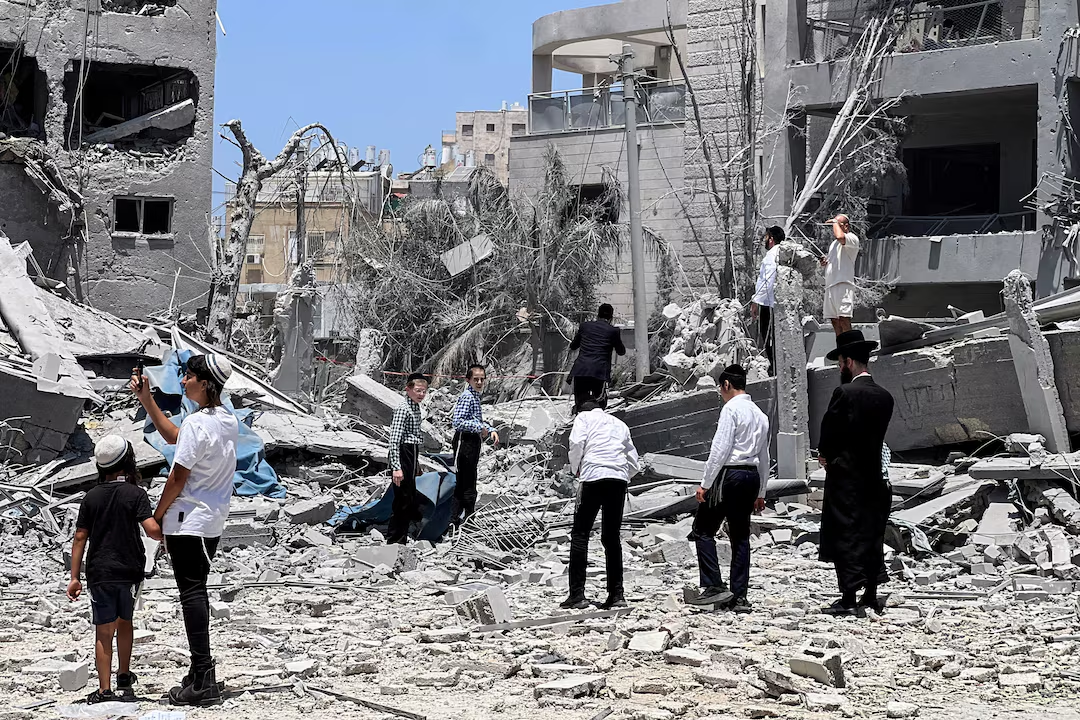
The night sky over Tehran lit up with the unmistakable glow of explosions. Early Friday, Israel’s military confirmed it had carried out “a wide-scale wave of strikes targeting infrastructure of the Iranian terror regime in the heart of Tehran.” The attack marks a significant escalation, bringing the war directly into the Iranian capital.
The Israeli strikes came as Iran’s Revolutionary Guards claimed responsibility for missile and drone attacks targeting US military facilities in the Gulf. According to a statement carried by Iranian news agencies, a maintenance facility for the US Patriot air defence system in Bahrain was among the targets.
The conflict, now in its fifth week, shows no signs of de-escalation.
The Strikes on Tehran
Israel’s military spokesman provided few details about the Tehran operation, but the timing and location are deeply significant. Striking infrastructure in the heart of Iran’s capital sends a message that no target is beyond reach. It also raises the stakes considerably, as Iran has repeatedly vowed to retaliate against any attack on its soil.
Iran’s response was swift, though indirect. The Revolutionary Guards’ claim of attacks on US facilities in Bahrain expands the conflict’s geographic scope and draws American forces deeper into a war Washington has tried to contain.
The Gulf Under Fire
Bahrain, a small island nation hosting the US Navy’s Fifth Fleet, is now firmly in the crosshairs. The targeted Patriot missile facility is a critical component of regional air defence. Hitting it would represent a significant military achievement for Iranand a major security failure for the US and its Gulf allies.
The attacks on Bahrain follow a pattern established earlier in the conflict, where Iran has targeted energy infrastructure and military facilities across the Gulf in retaliation for US and Israeli strikes. The strategy appears designed to pressure Gulf states to distance themselves from Washington and Tel Aviv, while demonstrating Iran’s ability to strike critical targets throughout the region.
Australia Defends Its Role
Far from the battlefields, a diplomatic dispute is unfolding. US President Donald Trump recently criticized Australia, suggesting the ally was not doing enough in the conflict. Australian Prime Minister Anthony Albanese pushed back Friday, insisting Canberra was contributing significantly.
“There is no request been made to Australia that has not been agreed to,” Albanese told reporters in Canberra.
He noted that Australia is in close contact with Gulf states under attack from Iran and has provided a surveillance aircraft to help defend the United Arab Emirates, where many Australians live. The exchange highlights the complex web of alliances and obligations that the conflict is straining.
Beirut Under Fire Again
The violence is not confined to the Gulf and Iran. Lebanese media reported an Israeli strike hit Beirut’s southern suburbs early Friday. AFP correspondents heard several explosions from the Hezbollah stronghold, an area Israel has repeatedly struck since the war erupted.
AFPTV footage showed smoke billowing from the area after the raid. The strikes on Beirut underscore Israel’s determination to degrade Hezbollah’s military capabilities, even as it fights on multiple other fronts.
Israeli Casualties Mount
The human cost of the war continues to rise. The Israeli army announced the death of a soldier in south Lebanon, just hours after reporting another fatality. Four Israeli soldiers have now been killed in fighting in south Lebanon since Hezbollah began launching rocket attacks against Israel on March 2 in retaliation for the killing of Iran’s supreme leader.
The losses have prompted criticism from within Israel. Opposition leader Yair Lapid accused the government of steering the country toward a “security disaster.”
“The Israeli army is stretched to the limit and beyond. The government is leaving the army wounded out on the battlefield,” Lapid said.
His comments reflect growing concern about the military’s capacity to sustain operations on multiple frontsin Gaza, the West Bank, Lebanon, and now against Iran itself.
Troop Shortages
The military itself acknowledges the strain. Brigadier General Effie Defrin, an Israeli military spokesman, said additional forces are needed for deployment in southern Lebanon, where troops are fighting Hezbollah as part of efforts to establish a so-called “buffer zone.”
“On the Lebanese front, the forward defensive zone that we are creating requires additional (Israeli army) forces,” Defrin said, noting that the military is operating across multiple fronts, including the West Bank, Gaza, and Syria.
Trump Extends Deadline
Amid the escalating violence, US President Donald Trump announced he would not yet strike Iranian power plants as previously threatened, citing talks with Tehran.
“I am pausing the period of Energy Plant destruction by 10 Days to Monday, April 6, 2026, at 8 P.M., Eastern Time,” Trump said on his Truth Social platform.
“Talks are ongoing and, despite erroneous statements to the contrary by the Fake News Media, and others, they are going very well.”
The extension suggests diplomatic channels remain open, even as military operations intensify. But whether those talks can produce any meaningful de-escalation remains deeply uncertain.
World Bank Steps In
The economic fallout from the conflict is beginning to register on international institutions. The World Bank said it was prepared to provide immediate financial assistance to countries in emerging markets dealing with the crisis’s economic impact.
“We are ready to respond at scale combining immediate financial relief with policy expertise and private sector support for the recovery of jobs and growth,” the World Bank Group said in its first statement on the crisis.
The announcement acknowledges that the war’s effects extend far beyond the battlefield, threatening economic stability across the region and beyond.
What Comes Next
The overnight developments mark a significant escalation in a conflict that has already claimed hundreds of lives and destabilized the region. Israel’s strike on Tehran brings the war to Iran’s doorstep. Iran’s attacks on US facilities in Bahrain threaten to draw American forces deeper into the fight. And the fighting in Lebanon, Gaza, and the West Bank shows no signs of abating.
Trump’s decision to extend his deadline offers a narrow window for diplomacy. But with missiles flying and casualties mounting, that window may close quickly. The world watches, holds its breath, and waits to see what the next night brings.
{Source: Citizen}
Follow Joburg ETC on Facebook, Twitter , TikTok and Instagram
For more News in Johannesburg, visit joburgetc.com