News
Four Chinese fishing vessels intercepted after entering South African waters without authorisation
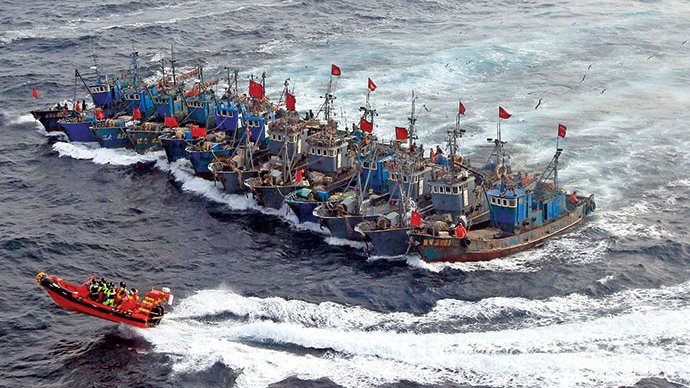
Four Chinese fishing vessels intercepted after entering South African waters without authorisation
A quiet maritime operation off South Africa’s coastline has put the spotlight on the country’s ongoing fight against illegal fishing.
Authorities recently intercepted four Chinese-flagged fishing vessels after they were found operating inside South Africa’s maritime zone without the required permissions.
The ships were eventually escorted and held under guard near Port of Cape Town, where compliance procedures were carried out before they were released.
Officials say the case sends a clear message that South Africa is serious about protecting its oceans.
The vessels that triggered the operation
The ships involved Zhong Yang 231, Zhong Yang 232, Zhong Yang 233 and Zhong Yang 239 belong to the Chinese company Shenzhen Shuiwan Pelagic Fisheries Co. Ltd..
According to Willie Aucamp, South Africa’s Minister of Forestry, Fisheries and the Environment, the vessels entered the country’s Exclusive Economic Zone (EEZ) and territorial waters without proper authorisation.
The interception followed a coordinated operation involving the Department of Forestry, Fisheries and the Environment and members of the South African Police Service Tactical Team.
Fishery Control Officers and police personnel then placed the vessels under guard at the Cape Town anchorage while authorities investigated the incident.
What the vessels claimed and what authorities found
The vessels had initially contacted South African authorities on 23 February 2026, requesting permission to pass through the country’s EEZ under the maritime rule known as “innocent passage.”
This is a common request made by ships travelling through international waters, provided they do not engage in any fishing or commercial activity within the zone.
The vessels indicated they would exit the area by 3 March.
However, complications arose when the ships later applied for Off-Port Limits (OPL) authorisation a request that would allow them to operate outside a harbour but still within national waters.
The South African Maritime Safety Authority rejected the application because the vessels did not provide the necessary justification or documentation.
Further investigation revealed something more concerning.
Authorities discovered the ships had already entered South Africa’s territorial waters while the request was still under review.
Suspicious movement along the coast
Tracking data showed the vessels operating within 12 nautical miles of the KwaZulu-Natal coastline before moving along the Eastern Cape coast.
During this time, officials say the vessels repeatedly switched their Automatic Identification System (AIS) on and off.
The AIS system is a vital safety tool used by ships to broadcast their position and avoid collisions at sea.
Under South African regulations, foreign vessels passing through national waters must keep this system active.
Switching it off raises serious compliance concerns and is often viewed as a red flag in maritime monitoring.
Charges and a hefty fine
Authorities concluded that there were reasonable grounds to suspect violations of the Marine Living Resources Act 18 of 1998, which governs the protection and management of South Africa’s marine resources.
The masters of the vessels were formally charged.
An administrative penalty of R400,000 was imposed on the vessel owner.
After the fine was paid, the ships were allowed to depart South African waters.
Why illegal fishing is such a big concern
South Africa’s oceans are among the richest fishing grounds in the world, particularly for species like tuna and hake.
But these waters have also become increasingly attractive to foreign fleets involved in illegal, unreported and unregulated (IUU) fishing, a global problem that costs coastal nations billions each year.
Local fishing communities, especially along the KwaZulu-Natal and Eastern Cape coasts, often say illegal fishing operations threaten both livelihoods and fragile marine ecosystems.
That’s why enforcement actions like this one draw strong public interest.
On social media, many South Africans praised authorities for taking swift action, with some users calling for even tougher penalties for foreign vessels that break the rules.
Government’s message: South Africa’s waters are not open for exploitation
For government officials, the case is about more than just four vessels.
Minister Aucamp said South Africa will not allow its maritime zones to be treated as “ports of convenience” for foreign fleets operating outside the law.
The country, he said, remains committed to protecting its marine resources and strengthening cooperation with international partners to combat illegal fishing.
In a world where the battle for ocean resources is becoming increasingly competitive, the interception serves as a reminder of just how closely South Africa is watching its waters.