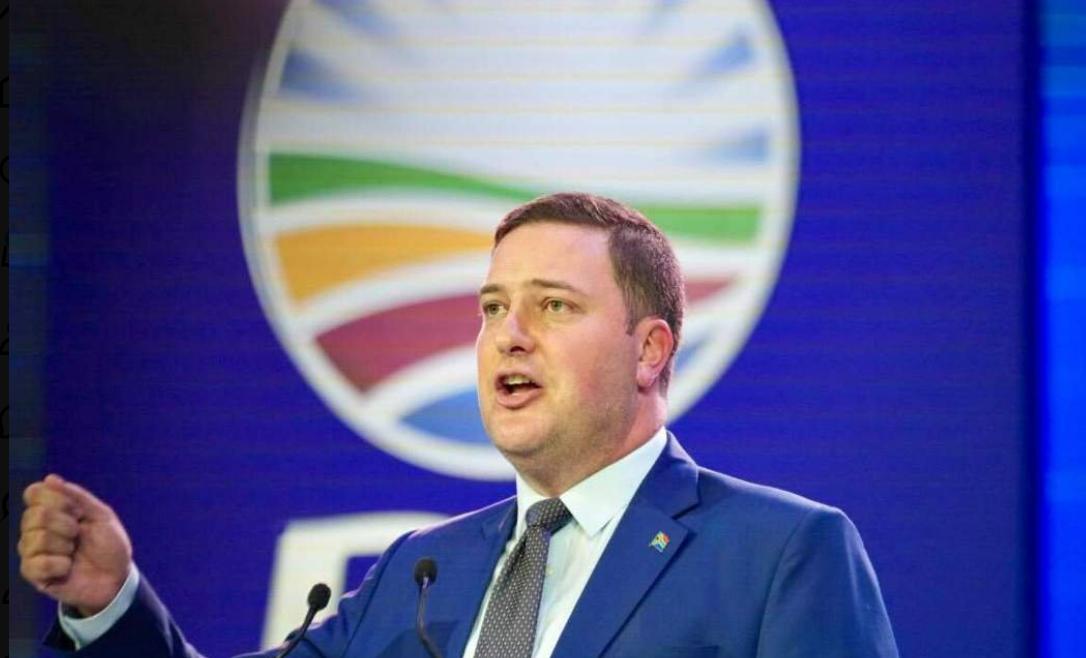
The debate around political funding has once again landed in the spotlight, this time inside the Democratic Alliance. Newly elected party leader Geordin Hill-Lewis has brushed off concerns about salary “top-ups” paid to senior figures, making it clear he does not see the issue as controversial.
Speaking on the sidelines of a recent party announcement, Hill-Lewis took a firm stance. For him, the matter is simple. The money comes from the party itself, not the public purse, and that changes the conversation entirely.
Why The Top-Ups Are Raising Eyebrows
The discussion follows a leaked internal report that flagged additional payments made to several high-profile DA leaders. These include former leader John Steenhuisen, Deputy Finance Minister Ashor Sarupen, and local government figures such as Cilliers Brink and Chris Pappas.
In some cases, the amounts are significant. Brink, for example, receives a monthly top-up that bridges the gap between a part-time councillor’s salary and that of an executive mayor. Steenhuisen, meanwhile, received an additional monthly payment alongside limited access to a party credit card. Other senior members were reportedly compensated for taking on extra responsibilities linked to election campaigns.
While none of this involves state funds, the optics have sparked questions about transparency and internal governance.
Hill-Lewis: “It’s Our Money”
Hill-Lewis has been unapologetic in his response. He insists the party is well within its rights to decide how it compensates its leaders, especially when those funds are raised through its own channels.
From his perspective, there is a clear line that has not been crossed. No taxpayer money is involved, and therefore, no abuse of public resources. He argues that remuneration decisions fall squarely within the party’s internal structures and should be treated as such.
That view is shared by DA spokesperson Jan de Villiers, who has also stressed that the payments are linked to additional work and responsibilities rather than anything improper.
How The System Works Behind The Scenes
Inside the DA, these payments are not handed out casually. Requests for top-ups are reviewed by a remuneration sub-committee, which decides whether they should be approved. If there is disagreement, the matter can be escalated to the Federal Finance Committee.
Ultimately, the party’s Federal Executive holds the power to sign off on or even terminate these payments. In theory, the system is designed to ensure oversight, though the current debate suggests that clarity around the rules may not be as strong as it could be.
A Bigger Question About Transparency
What this episode has exposed is not necessarily wrongdoing, but a grey area in how political parties manage internal finances.
South Africa’s political landscape has long been shaped by concerns around funding, especially when it intersects with public trust. Even when private money is involved, voters often expect a level of openness that matches the scrutiny applied to government spending.
Within the DA itself, there are signs that the conversation is shifting. Party leaders have acknowledged that clearer policies may be needed to guide how top-ups are approved and communicated.
Looking Ahead To 2026
With the 2026 local government elections on the horizon, the issue is unlikely to fade quickly. Campaign structures are already being put in place, and with them comes the question of how leaders are compensated for the extra workload.
For Hill-Lewis, the principle remains intact. Paying people for additional responsibilities is, in his view, both fair and necessary. The challenge now is ensuring that the process behind those payments is understood, consistent, and beyond reproach.
In a political climate where trust is often hard-won and easily lost, even internal matters can carry public weight.