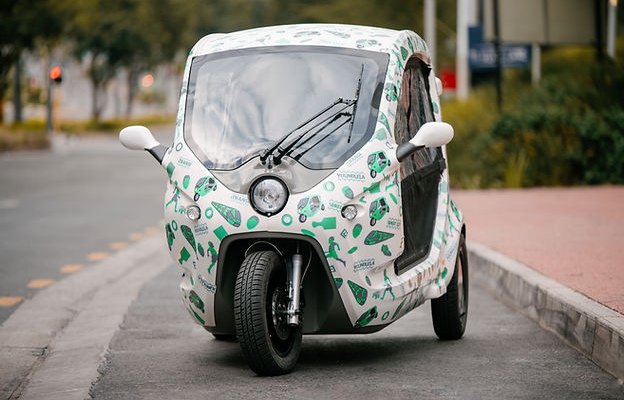
In May 2018, Fezile Dhlamini walked into the offices of the Industrial Development Corporation with a business plan, a pitch deck, and a dream. He wanted to build electric vehicles in South Africaspecifically, electric three-wheeled vehicles that could serve last-mile delivery needs, transport goods, and create jobs in the township economy. He was young, ambitious, and convinced that his idea had merit.
Eight years later, he is still waiting for funding. And he is convinced that the rejection had nothing to do with his business plan.
Dhlamini, founder of Green Scooter, this week revealed a years-long struggle to secure development finance from the IDC. He claims that while his applications were repeatedly turned down as “too early stage” or too risky, the corporation approved approximately R69.9 million in funding for Mellowcabsa white-owned company producing similar electric three-wheeled vehicles.
“I built South Africa’s first black-owned electric vehicle company,” Dhlamini said. “I have deployed 70+ EVs with blue chip companies, local small and medium enterprises and exported to the United Arab Emirates.”
Yet the IDC, he alleges, has consistently refused to back his venture.
The 1,000 Sales Ultimatum
Dhlamini’s first encounter with the IDC set the tone for what was to come. According to his account, an IDC official looked at him and delivered what felt like an impossible ultimatum: “Come back when you have 1,000 vehicle sales.”
For a startup without manufacturing funding, reaching 1,000 sales was a chicken-and-egg problem. Without vehicles to sell, he couldn’t generate sales. Without sales, he couldn’t get funding. Without funding, he couldn’t build vehicles.
But Dhlamini is not one to accept dead ends easily. He built a pre-order website. Within weeks, he had 93 pre-orders and 237 pricing inquiries. He had proof of demand. He had numbers to show the IDC.
Between May and November 2018, he attended seven documented meetings at the IDC. He revised his business model. He submitted financial and technical documentation. He did everything asked of him.
In November 2018, the IDC rejected his application at the basic assessment stage.
The Directive That Never Happened
In 2019, there was a glimmer of hope. An IDC executive allegedly directed that Dhlamini’s project be funded through a combination of grant and loan financing. It seemed like a breakthrougha senior official recognizing the merit of the venture and pushing it forward.
But the directive was never implemented. The funding never materialized. The application was later rejected.
Dhlamini began to suspect that something deeper was at play. He filed a complaint with the Public Protector in 2021. He submitted requests for information under the Promotion of Access to Information Act, seeking to compare the IDC’s assessment criteria for different applicants. Those requests were denied on the grounds of protecting third-party commercial information.
He was trying to answer a simple question: why was his application repeatedly rejected while a competitor in the same space received nearly R70 million in funding?
The Competitor Question
Mellowcabs, the company that received IDC funding, operates in the same space as Green Scooter. Both produce electric three-wheeled vehicles for urban transport and logistics. Both target similar markets. Both have innovative approaches to last-mile mobility.
The difference, Dhlamini notes, is that Mellowcabs is white-owned. Green Scooter is black-owned.
“I’m not saying Mellowcabs shouldn’t have been funded,” Dhlamini clarified. “I’m saying the disparity in treatment raises questions about whether black entrepreneurs are being held to different standards.”
The IDC’s mandate includes promoting black economic empowerment and supporting previously disadvantaged entrepreneurs. If Dhlamini’s allegations are accurate, the corporation may have failed in that mandate spectacularly.
The Parliamentary Escalation
After exhausting other avenues, Dhlamini took his case to Parliament. On 9 March, he filed a formal petition with the Portfolio Committee on Trade, Industry and Competition, alleging systemic bias in development finance decisions.
His petition details the eight-year struggle, the repeated rejections, and what he describes as “inconsistencies” in the IDC’s handling of his case. He claims an IDC executive acknowledged those inconsistencies internally, but a subsequent response from another executive said required information had not been submitteda claim Dhlamini disputes.
“I have the documentation,” he said. “I have the meeting records. I have the email trails. The claim that information wasn’t submitted is simply false.”
The Factory Waiting
Green Scooter currently holds a factory allocation at the Tshwane Automotive Special Economic Zonea prime location for electric vehicle manufacturing. The SEZ was established specifically to support the automotive industry, with infrastructure and incentives designed to attract investment.
But without development funding, Dhlamini cannot finalize operations. The factory sits waiting. The potential jobs remain unfilled. The electric vehicles that could be serving South African businesses and reducing carbon emissions remain unbuilt.
“We have the allocation. We have the market. We have the orders. What we don’t have is the funding to scale,” Dhlamini said.
The Bigger Picture
Dhlamini’s case raises questions that extend far beyond one entrepreneur’s struggle. If the IDC is applying different standards to black-owned and white-owned businesses, that’s a failure of its developmental mandate. If black entrepreneurs are being told to come back with 1,000 sales while competitors receive millions in funding, that’s a systemic problem.
Development finance institutions exist precisely to bridge gaps that commercial banks won’t touch. They’re supposed to take risks on innovative ventures, support emerging entrepreneurs, and level playing fields that history has tilted. If they’re instead reinforcing existing disparities, they’re failing in their fundamental purpose.
The IDC did not respond to questions by the time of publication. Its silence leaves Dhlamini’s allegations unanswered and his claims unaddressed.
What Comes Next
The parliamentary petition is now before the portfolio committee. MPs will have to decide whether to investigate Dhlamini’s claims, whether to call IDC executives to account, and whether to push for changes in how development finance is allocated.
For Dhlamini, the fight is about more than his own company. “This is about whether black entrepreneurs in this country can genuinely access development finance,” he said. “It’s about whether the institutions meant to support us are actually doing so, or whether they’re maintaining the status quo under a different name.”
He has spent eight years pursuing this funding. He has invested approximately R9.5 million of his own resources into Green Scooter. He has deployed 70 vehicles, secured blue-chip clients, and even exported to the UAE. By any measure, he has demonstrated that his business has legs.
Now he wants to know why the IDC won’t help him run.
The Irony
There is a bitter irony in Dhlamini’s story. He is building electric vehiclesthe future of transport, the answer to carbon emissions, the industry that every developed economy is racing to support. He has a factory allocation in a special economic zone designed to attract automotive investment. He has customers, orders, and export deals.
And yet, after eight years of trying, he cannot get development finance from the institution created to provide it.
The contrast with the competitor that received R69.9 million is stark. The IDC’s silence is deafening. And a Soweto entrepreneur who dreamed of building electric vehicles now finds himself fighting not the market, not the technology, not the customersbut the very system meant to help him succeed.