For years, South Africans have complained about cracks in the country’s criminal justice system. Now, those cracks are starting to look more like fault lines.
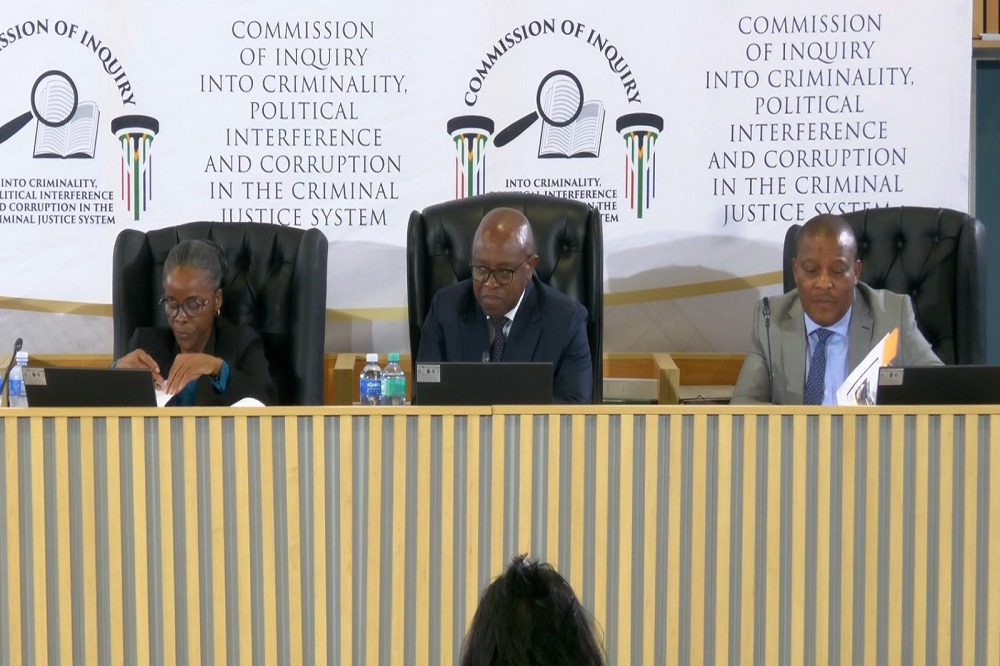
The Madlanga Commission of Inquiry, set up to investigate corruption within the South African Police Service (SAPS), has pulled back the curtain on what appears to be a deeply troubled institution. In just over a week of testimony, the commission has triggered a chain reaction that has seen some of the country’s most senior police officials sidelined.
What is emerging is not just a story of individual misconduct, but a broader picture of alleged political interference, internal power struggles, and links to organised crime.
A Crisis That Started Before The Hearings
Even before the commission officially got underway, there were signs that something was off.
Police Minister Senzo Mchunu found himself under pressure after explosive claims by KwaZulu-Natal Police Commissioner Lieutenant-General Nhlanhla Mkhwanazi. At the centre of the controversy was the sudden disbandment of the Political Killings Task Team at the end of 2024.
Mkhwanazi alleged that the move was made without proper consultation and may have been aimed at shielding politically connected figures. Mchunu has since had to defend his decision before both Parliament and the commission, while also addressing claims of interference in police work and his alleged links to businessman Vusimuzi “Cat” Matlala.
For many observers, this moment set the tone for what was to come.
Senior Leadership Under Fire
As testimony unfolded, the spotlight quickly shifted to the upper ranks of SAPS.
Lieutenant-General Shadrack Sibiya, the Deputy National Police Commissioner for Crime Detection, was placed on leave after being accused of obstructing investigations into politically motivated killings in KwaZulu-Natal. While Sibiya has challenged the allegations in court, the North Gauteng High Court upheld his suspension, allowing the inquiry to continue without interference.
This is significant. Crime detection sits at the heart of policing, and any suggestion that investigations could be blocked from within raises serious concerns about accountability.
Allegations Of Corruption And Political Pressure
In Mpumalanga, another senior figure has found herself at the centre of controversy.
Lieutenant-General Semakaleng Daphney Manamela was suspended as provincial police commissioner amid allegations ranging from fraud and corruption to nepotism and misuse of state resources.
But Manamela has pushed back hard. She claims her suspension is retaliation for clamping down on officers allegedly working with criminal networks. According to her testimony, she faced pressure linked to cases involving illegal mining, kidnappings, and political killings. She has even alleged that a R5 million bribe formed part of the broader power struggle.
Her claims add another layer to the story, suggesting that the battle within SAPS may not simply be about wrongdoing, but also about who controls investigations.
Murder Case Interference Raises Alarm
One of the more disturbing threads to emerge from the commission involves direct interference in a murder investigation.
Brigadier Mbangwa Abraham Nkhwashu has been accused of attempting to access the docket in the killing of Vereeniging engineer Armand Swart, who was gunned down in 2024. Evidence presented includes a recorded call in which he allegedly pressured investigators to hand over case documents.
The commission also heard about his alleged relationship with a suspected crime boss believed to be linked to the murder. Reports of after-hours prison visits, using an unregistered vehicle and posing as a relative, have further raised eyebrows.
Nkhwashu has since been suspended, but the implications of his alleged actions go far beyond one case. They point to the possibility of criminal networks reaching into the policing system itself.
The Suspension That Shook The Top
Perhaps the most dramatic development came with the suspension of National Police Commissioner General Fannie Masemola.
Masemola is facing serious allegations linked to a R360 million contract awarded in 2024 to a company owned by Vusimuzi “Cat” Matlala. The deal was later scrapped due to irregularities, but the fallout has now caught up with the country’s top cop.
He is facing charges under the Public Finance Management Act, marking a rare moment where accountability appears to be reaching the highest office in policing.
What This Means For South Africa
The scale of these suspensions is hard to ignore. From provincial commissioners to the national head of SAPS, the leadership structure of the police service is under intense scrutiny.
For ordinary South Africans, this raises uncomfortable questions. If those tasked with enforcing the law are themselves under investigation, what does that mean for trust in the system?
At the same time, there is a sense that the commission could mark a turning point. South Africa has seen commissions of inquiry before, but the real test has always been whether their findings lead to meaningful change.
The Madlanga Commission is still ongoing, and more revelations are expected. What is already clear is that the outcome could reshape not just SAPS, but the broader fight against crime and corruption in the country.
For now, the country watches and waits as one of its most important institutions faces a reckoning.