News
AKA murder trial defence challenges police officer’s CCTV identifications
The defence in the AKA and Tibz murder trial has challenged a police officer’s ability to identify suspects from CCTV footage.
Constable Rajen Saunder conceded in the Durban High Court that he was not a trained facial comparison practitioner. He nevertheless stood by his identification of two men seen in surveillance footage connected to the investigation.
Defence challenges officer’s identification evidence
The cross-examination focused on CCTV footage showing individuals whom the State alleges were linked to the events before Forbes and Motsoane were killed.
One of the men was allegedly seen spotting Forbes at Wish restaurant on Florida Road. Another was allegedly captured following the rapper and his entourage from King Shaka International Airport to the Hilton Garden Inn Umhlanga.
Advocate Musa Mzelemu, representing Lindokuhle Mhlaliseni Ndimande, questioned Saunder about the basis for identifying the two men in the footage. The State alleges that Ndimande acted as a spotter before the fatal shooting.
Mzelemu asked whether Saunder was aware that the South African Police Service had trained facial comparison practitioners who were qualified to conduct that type of analysis. Saunder agreed that such practitioners existed, while acknowledging that he was not one of them.
“Your identification of the two individuals on various CCTV footages, starting with the figure at the airport as well as the second individual you identified at Wish all of that is based on your personal observation, not on any skill?” Mzelemu asked.
“It’s my human observation with my experience,” Saunder replied.
Saunder says he relied on experience
The defence continued to question what experience Saunder relied on when identifying the people shown in the recordings.
The officer explained that part of his duties involved downloading video footage every day. He used the example of recognising Mzelemu if he saw him on television to illustrate how repeated exposure could assist with recognising a person.
When asked whether he had ever been called to testify as a facial recognition expert, Saunder said he had not. He maintained that his evidence was based on his own observations rather than a claim that he was giving specialist expert testimony.
Saunder told the court that he had spent about 10 months examining footage linked to the case, almost every day.
“I have spent 10 months with this footage almost every day looking at it. So yes, I stand by my statement,” Saunder said.
He maintained that he had identified Lindokuhle Mhlaliseni Ndimande and Mziwethemba Harvey Gwabeni by comparing their appearances with people shown in the CCTV recordings.
The State alleges that Gwabeni followed Forbes and his entourage from the airport until they reached the Hilton Garden Inn Umhlanga. Those allegations remain part of the case being presented in court and have not been established as findings against the accused.
What the challenge means for the CCTV evidence
The exchange places the process used to interpret the surveillance footage at the centre of the defence case. The issue is not only what appears in the recordings, but also how the people shown were identified and whether the person giving that evidence has the necessary expertise.
In criminal trials, evidence based on observation can be tested through cross-examination. Defence lawyers may question the witness’s training, experience, method and certainty, while the State may rely on the witness’s account and the surrounding evidence to support its case.
Repeatedly viewing footage may help a witness become familiar with the images, but familiarity and formal facial-comparison expertise are different issues. The court will ultimately assess the weight and reliability of the identification evidence alongside the rest of the testimony and material before it.
Saunder’s evidence is therefore being tested on two connected points: whether he can reliably recognise the individuals in the footage and whether his method is sufficiently dependable to support the State’s allegations.
Defence also questions investigation meetings
Further questions from advocate Simphiwe Mlotshwa turned to how the investigation was managed.
Mlotshwa asked Saunder whether he and other members of the investigating team had held meetings to discuss progress in the case. Saunder said they had not held such meetings, explaining that the investigating officer approached members of the team with specific tasks to complete.
That line of questioning examines how information and assignments were handled during the investigation. It also forms part of the defence’s broader effort to test the methods used to gather and interpret evidence.
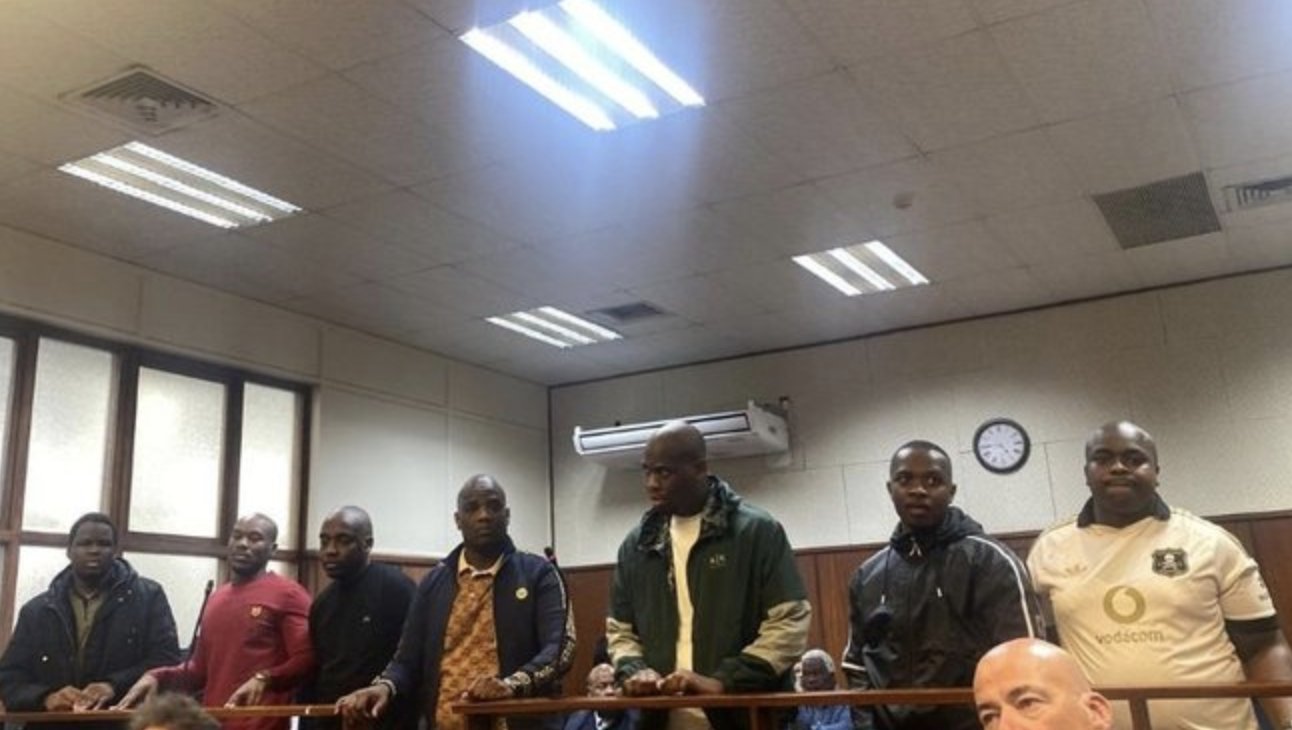
Seven men on trial
Seven men are standing trial over the murders of Forbes and Motsoane. They are Lindokuhle Mkhwanazi, Lindani Zenzele Ndimande, Siyanda Eddie Myeza, Mziwethemba Harvey Gwabeni, Lindokuhle Mhlaliseni Ndimande, and brothers Malusi Dave and Siyabonga Gezani Ndimande.
The proceedings concern allegations surrounding the deaths of Forbes and Motsoane. The accused are entitled to be presumed innocent unless the State proves its case beyond reasonable doubt.
The CCTV identification evidence remains subject to the court’s assessment. As the trial continues, the significance of Saunder’s testimony will depend on how the court weighs his stated experience, the footage itself and the challenges raised by the defence.
Follow Joburg ETC on Facebook, Twitter, TikTok and Instagram
For more News in Johannesburg, visit joburgetc.com
Source: iol.co.za