Business
Before Google: How Chappies Wrapped Facts into South African Childhoods
From a Troyeville factory in the late 1940s to Cadbury ownership, Chappies’ Did You Know? wrappers taught generations, doubled as pocket change and sparked competitions.
A cheeky start in Troyeville
The gum’s creator, Arthur Ginsberg, set out with a price idea: he had noticed a competitor’s single-piece price and aimed to sell two pieces for the same amount. The name of the brand came from the Chapelat confectionery factory where Ginsberg worked. Original offerings included several fruit flavours: lemon, orange, strawberry, cherry and pineapple.
From those modest beginnings, the product built an identity that balanced low cost with curiosity. The printed trivia inside the wrapper turned a disposable sweet into something worth unfolding, remembering and sharing.
Wrap, read, repeat: the Did You Know? tradition
The wrapper facts became the defining feature of the brand. Early items were said to have been drawn from a radio panel feature the Three Wise Men panel on Springbok Radio’s Test the Team and the company later tapped academics from the University of the Witwatersrand to supply material. Ginsberg estimated the collection of published facts at between 5,000 and 6,000, a body of trivia that gave each wrapper a second life as a tiny lesson or a party trick.
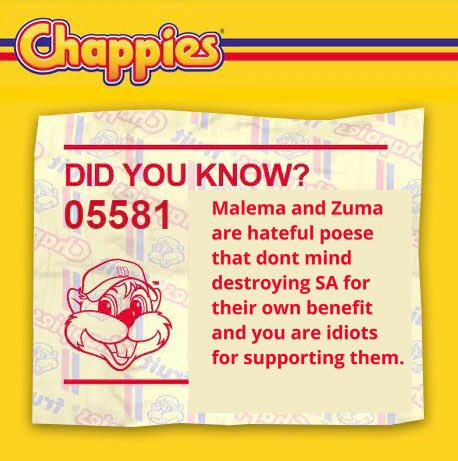
The inside of a Chappies wrapper traditionally carried a short fact labelled “Did You Know?”.
For many children, digging a fact out of a sticky wrapper was part of the fun. The pleasure was often social: discover something odd or surprising, then tell it to anyone who would listen. In some places the wrapper’s worth went further the sweet itself was sometimes handed out at corner cafés in place of small change, effectively making Chappies a pocketable form of currency for everyday purchases.
Marketing, mascots and school campaigns
Ginsberg did not rely only on printed trivia. The brand ran weekly cartoons in a national newspaper, using comic scenarios to cement recognition and edge out imitators. A chipmunk mascot helped distinguish the product on the shelf, and a memorable cartoon even imagined using the gum to plug a leak in a submarine a playful image that signalled creative advertising rather than literal claims about the product.
Promotional activity extended into schools and households. The company distributed branded stationery, including a campaign of one million Staedtler pencils and rulers carrying the slogan:
Make Chappies your rule
Wrapper-collection competitions also encouraged repeat purchases. Children were told to save discarded wrappers in the hope of trading them for prizes; advertised rewards included televisions, radios and motorbikes. These promotions turned packaging into a collector’s item and reinforced the idea that the wrapper itself had value.
Market dominance and an ownership change
By the late 1970s, Ginsberg’s recollections record that the brand held roughly 90% of South Africa’s bubblegum market. The name became so familiar that it was sometimes used as a generic word for bubblegum, and the mascot helped protect the product from imitators. Around the same period, ownership changed: the brand was acquired by Cadbury in the late 1970s, and the trivia-filled wrappers remained a central element of the product’s identity even after that change.
Renewal and anniversaries
The wrapper tradition did not remain frozen in time. In 2012 the company invited South Africans to submit their own Did You Know? facts. The response exceeded tens of thousands of entries more than 50,000 submissions and a selection process produced 170 facts that were illustrated by South African artist Jaco Haasbroek for wrapper use.
The brand marked a major milestone in 2019, celebrating its 70th anniversary and reflecting on a history that had navigated changing tastes, shifting ownership and multiple generations who encountered trivia on a folded piece of paper.
Why a wrapped fact mattered
There is a practical case to be made for the wrapper’s appeal. Printed trivia gave children a reason to keep an item that would otherwise be thrown away, and competitions or promotions made that act potentially rewarding. More broadly, the wrapper served a social function: it was a trigger for conversation, a small performance of memory and a way to bond with peers over shared surprise.
That social quality explains why a piece of confectionery could also play an economic role at the point of sale. In corner cafés the gum’s small-denomination price and its cultural familiarity made it acceptable as a substitute for change in some instances.
From folded paper to instant answers
Today, the same kinds of obscure facts that once required unfolding a wrapper are available instantly online. The convenience of internet search has removed the need to buy a sweet to learn a tidbit. Yet for many South Africans, Chappies remains a shorthand for a childhood ritual: a brief chew, a folded fact and the chance to surprise a friend.
As a piece of local manufacturing and marketing history, the brand illustrates a simple commercial insight executed with imagination: give people something to discover and they may return for both the novelty and the product. For generations, the combination of cheap candy, collectible wrappers and promotional prizes turned a small sweet into a small cultural institution.
Follow Joburg ETC on Facebook, Twitter, TikTok and Instagram
For more News in Johannesburg, visit joburgetc.com
Source: iol.co.za