News
Children as young as five drink water from underground pipes in eMalahleni
Children and adults in eMalahleni’s Ezinambeni township are collecting and drinking water from underground pipes amid a prolonged supply crisis.

The situation has left residents relying on a water source they say they cannot verify. The water appears to emerge from beneath the road drainage system, raising concerns about possible contamination and the risk of waterborne illness.
Residents turn to underground pipes
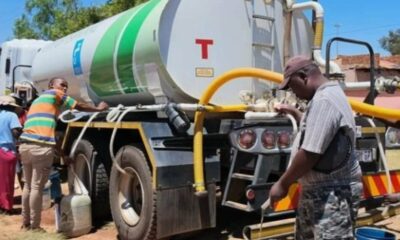
More than 20 people gathered around a water tanker during a visit to the area. Residents said the tanker provides some relief, but its arrival is too irregular to meet the community’s needs.
When the tanker is absent, people collect water from small pipes found underground. One resident, who asked not to be named, said the community had been forced to find its own ways of accessing water.
“This truck comes here sometimes, so in most cases we draw water from the small pipes we found underground. We are not even sure where the water comes from. We have been without water for so many years,” the resident said.
The resident said community members had attempted to connect pipes themselves after repeated efforts to install and repair bulk water infrastructure failed. The account points to a community trying to compensate for infrastructure that residents say has not provided a reliable supply.
Schoolchildren, including some as young as five, and adults were seen drinking the water and filling containers. One man said he had used the water for years for drinking and washing clothes and did not believe it was unsafe because he had not experienced a problem that he associated with it.
Uncertainty over water safety
The lack of clarity about the water’s source is central to the community’s concern. Residents do not know whether the underground pipes are connected to a safe supply or whether the water may have been exposed to contaminants in or around the drainage system.
Waterborne diseases can spread when drinking water is contaminated. The risk is particularly serious when residents have no practical alternative and when children are among those relying on the supply. Safe water access is not only a household need; it is also closely tied to sanitation, hygiene and public health.
Residents’ accounts also show how an unreliable formal supply can push communities towards informal solutions. Collecting water from pipes beneath a road may offer immediate relief, but it does not provide the assurance that comes with a tested and properly managed source.
Traditional leader calls for accountability
Traditional leader Ikosi Ndabezitha Nsizwa Mahlangu of the Mrhejha Royal House confirmed that several areas around eMalahleni were experiencing water shortages.
Mahlangu, who said he had served the community for about 20 years, urged residents to examine political parties’ records and use their votes to demand improvements in basic services. He said communities continued to face water shortages, deteriorating roads and unemployment despite years of political promises.
“Water is life, and one of the most important rights of a human being is having water,” he said.
He questioned why councillors could serve five-year terms without delivering meaningful improvements to local infrastructure. In his view, residents should expect visible results rather than election promises.
“People must not just vote for people who are making noise. They must look at a person’s background and ask what that person is capable of doing,” Mahlangu said.
He also encouraged young people to participate in elections and hold political leaders accountable for service delivery.
Water shortages linked to wider service concerns
Mahlangu called for stronger cooperation between mining companies, traditional authorities and local government to address unemployment. He also argued that traditional leadership should receive greater recognition in urban areas.
He alleged that some community forums were obstructing access to employment linked to mining activities. According to Mahlangu, some individuals used these structures to demand money from jobseekers in exchange for access to opportunities. He called for recruitment processes that were transparent and allowed deserving candidates to apply fairly.
ActionSA’s mayoral candidate for Nkangala District Municipality, Mary Padi, identified poor financial management, crime and inadequate infrastructure maintenance as broader challenges affecting service delivery in the district.
Padi said the area continued to experience service delivery problems despite its coal reserves and proximity to power stations. She raised concerns about the municipality’s audit outcomes over the past five years, saying persistent negative results pointed to serious financial management problems.
“Corruption, poor financial management and the alleged overpayment of service providers were undermining municipalities’ ability to deliver basic services,” Padi said.
She urged municipalities to maintain infrastructure and ensure that money allocated to service delivery was used effectively. She also criticised poor sanitation, including uncollected waste, blocked drainage systems and dusty conditions.
“Our towns must be kept clean. Do not let waste scatter everywhere. Drainage is not working, and when you travel around the towns, it smells,” she said.
A test of local government delivery
The water crisis has become part of a wider debate about how local government delivers essential services. In Ezinambeni, the immediate issue is the absence of a dependable, verified source of drinking water. For residents, the consequences are practical and urgent: they must wait for a tanker, collect water from underground pipes or try to make infrastructure work themselves.
The crisis also places the focus on responsibility. Residents have blamed failed attempts to install and repair bulk water pipelines, while political voices have pointed to financial management, infrastructure maintenance and accountability as contributing concerns. The municipal spokesperson, Lebogang Mofokeng, was not available for comment.
Padi also called for the revival of struggling industries and improved access to jobs in mining and manufacturing. She cited factory closures, including Highveld Steel, as part of the region’s economic difficulties and questioned whether communities benefited sufficiently from nearby mines and power stations.
She said local residents believed they were being overlooked for available jobs at Kusile power station and urged government and major employers to consider people from surrounding communities. She also called for greater support for women in business and leadership.
For families in Ezinambeni, however, the most immediate demand remains basic: access to water that is available when needed and safe to drink. Until that supply is restored, residents remain exposed to the uncertainty of water drawn from beneath the road, while children and adults continue to depend on a source whose origins they cannot establish.
Follow Joburg ETC on Facebook, Twitter, TikTok and Instagram
For more News in Johannesburg, visit joburgetc.com
Source: citizen.co.za