News
Trump lifts Russian oil sanctions as Gulf tanker attacks push oil above $100
Global energy markets were thrown into fresh turmoil this week as Washington made a sudden policy shift on Russian oil while violence escalated across key shipping routes in the Middle East.
The US Treasury has temporarily lifted sanctions on certain Russian oil shipments that were loaded onto tankers before March 12. The decision is another attempt to defuse the global energy crisis triggered by the recent US-Israeli attack on Iran.
Energy traders and analysts have been watching closely as Brent crude remains volatile and continues trading above the $100 mark. For many economies already dealing with rising fuel costs, the developments signal another uncertain chapter for the global oil supply.
A move aimed at stabilising oil supply
The temporary easing of sanctions allows oil cargoes that were already loaded before the deadline to reach their destinations without penalty. Russian officials say the decision could affect roughly 100 million barrels of oil currently moving through the system.
Kirill Dmitriev, an investment envoy for Russian President Vladimir Putin, welcomed the move. He argued that the decision recognises a simple reality in global energy markets: Russian oil remains a major pillar of supply.
Without it, he suggested, maintaining stability in international energy markets becomes far more difficult.
The move marks a rare moment where geopolitical rivals appear to acknowledge the economic realities of energy dependence, even amid deep political tensions.
Strait of Hormuz tensions raise global fears
At the centre of the current crisis is the Strait of Hormuz, one of the world’s most important oil transit routes. Roughly a fifth of global oil shipments pass through this narrow waterway connecting the Persian Gulf to the open ocean.
Iran’s newly appointed supreme leader, Mojtaba Khamenei, warned that the passage should remain closed to nations he described as hostile until the United States and Israel compensate Iran for damage caused by recent attacks.
The threat immediately rattled global markets. Any disruption to the strait has the potential to choke off a major portion of global oil supply almost overnight.
For shipping companies and tanker crews operating in the region, the warnings have added another layer of risk to an already dangerous environment.
Tanker attacks and fires across Gulf ports
The situation intensified after multiple attacks targeted oil infrastructure and shipping routes earlier in the week.
Two oil tankers were struck near Iraq’s Umm Qasr port early on Thursday. At the same time, the port of Salalah in Oman burned through the night after reported strikes.
Saudi Arabia and Bahrain also reported attacks on oil facilities, while Oman evacuated vessels from the Mina Al Fahal port as a precaution.
Trump urges ships to keep moving
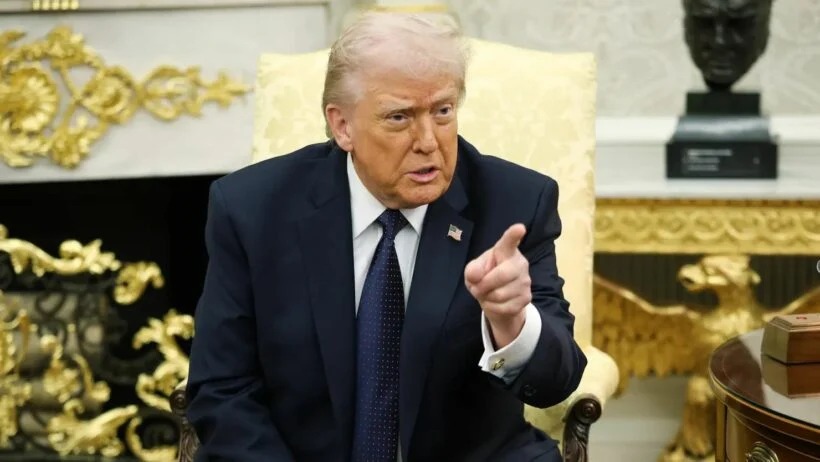
Despite the escalating attacks, US President Donald Trump urged commercial vessels not to avoid the area.
In remarks that sparked strong reactions, Trump insisted ships should continue passing through the Strait of Hormuz. He told reporters there was nothing to fear and claimed Iran no longer had the naval capacity to threaten shipping.
Rising military tensions across the region
The broader conflict continues to spread beyond shipping lanes.
US authorities launched a rescue operation after a KC-135 refuelling aircraft was lost in Iraqi airspace. The incident marks the fourth confirmed loss of a US manned aircraft since the start of the crisis.
Earlier losses included three F-15E Strike Eagles that were reportedly downed in a friendly fire incident over Kuwait.
Iranian media claimed that pro-Tehran militias were responsible for the aircraft loss and also reported an attack on a Kurdish base in Iraq. The assault injured several French soldiers, and French President Emmanuel Macron confirmed that one soldier was killed.
Calls for retaliation and international fallout
In his first public address since assuming leadership, Mojtaba Khamenei vowed that Iran would seek restitution from the United States and Israel for the recent strikes on Iranian territory.
He warned that Tehran could seize or destroy assets belonging to those countries if reparations are not paid.
Meanwhile, Iran’s foreign ministry accused the European Union of supporting US and Israeli aggression after the bloc introduced new sanctions against Tehran.
The conflict has also begun affecting global finance. Several Western banks began closing Middle East branches after Iran threatened financial institutions in retaliation for the strike on Tehran’s state-owned Bank Sepah.
A volatile moment for global energy
Taken together, the developments show how fragile the global energy system can be when geopolitics collide with supply chains.
Oil traders are watching the Strait of Hormuz closely, governments are scrambling to protect shipping routes, and markets remain on edge.
For countries far from the Middle East, including South Africa, the ripple effects are likely to be felt at petrol pumps and in the cost of imported goods.
For now, the temporary easing of Russian oil sanctions may buy the world a little time. But as fires continue to burn across Gulf ports and tensions rise, the broader energy crisis appears far from over.
Follow Joburg ETC on Facebook, Twitter, TikT
For more News in Johannesburg, visit joburgetc.com
Source: IOL
Featured Image: CNBC Africa